A New Regional Quartet: Is the Middle East Moving Toward a Collective Security Framework?

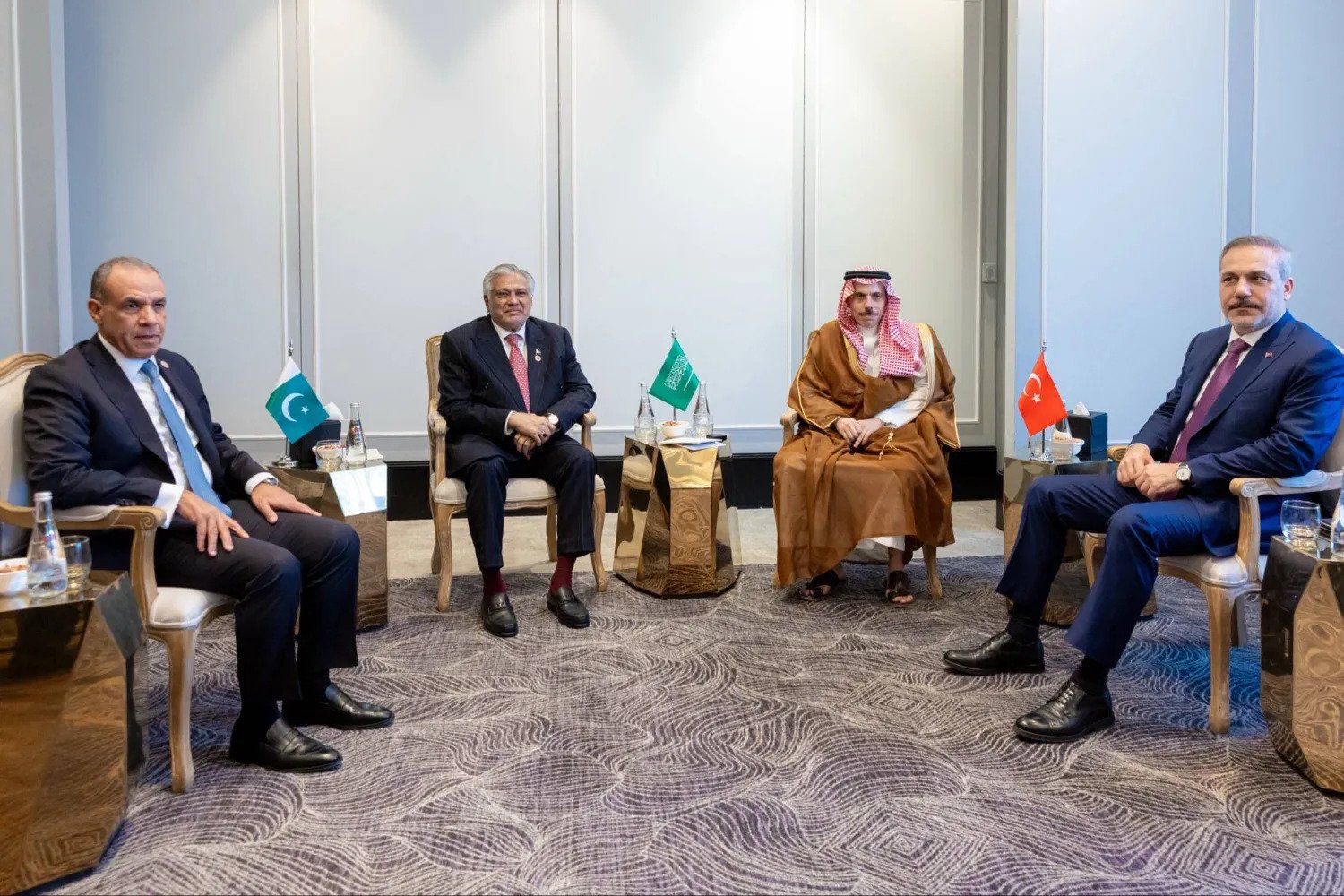
The fifth meeting of the foreign ministers of Saudi Arabia, Egypt, Türkiye, and Pakistan in Amman was more than a routine diplomatic consultation on regional developments. It may, in fact, signal the gradual emergence of a new regional framework for crisis management—one that brings together four influential powers whose combined political, military, and geographic weight stretches from the Eastern Mediterranean to the Gulf and the Indian Ocean.
At a time when the Middle East is experiencing an unprecedented convergence of crises—from the war in Gaza and escalating U.S.-Iran tensions to growing threats against maritime navigation in the Red Sea and the Strait of Hormuz—the four countries appear to be shifting from a reactive posture toward a more proactive approach aimed at coordinating regional responses before crises spiral out of control.
Perhaps the most significant aspect of the meeting's final communiqué was not merely its emphasis on diplomatic solutions, but its deliberate linkage of three interconnected priorities: de-escalation, respect for state sovereignty, and the security of strategic maritime routes. This reflects a growing recognition that regional security can no longer be measured solely by the absence of armed conflict. It is now equally dependent on safeguarding international trade routes and energy flows, both of which have become essential pillars of global economic stability.
Viewed from this perspective, the group's support for the Pakistani-Qatari mediation efforts carries important strategic implications. Rather than positioning themselves within the polarized confrontation between Washington and Tehran, the four states appear to be carving out diplomatic space that allows them to facilitate dialogue and support conflict de-escalation without becoming direct participants in the confrontation itself.
The composition of the quartet further enhances its strategic significance.
Saudi Arabia represents the Gulf's largest energy producer and a leading Arab power. Egypt controls the Suez Canal, one of the world's most critical maritime chokepoints. Türkiye occupies a pivotal geopolitical position linking the Black Sea and the Mediterranean, while Pakistan, as a nuclear-armed state with balanced relations across much of the Islamic world, possesses diplomatic leverage extending well beyond South Asia.
Together, these states form a geopolitical arc that could provide the foundation for a broader regional consultative mechanism capable of influencing the Middle East's evolving security architecture.
The ministers' emphasis on securing both the Strait of Hormuz and Bab el-Mandeb also reflects a notable evolution in regional strategic thinking. These waterways are no longer viewed merely as maritime passages; they have become central arenas in the struggle over energy security, global supply chains, and international economic stability. Any disruption in either corridor now reverberates far beyond the Middle East, affecting markets and trade worldwide.
Equally noteworthy was the ministers' endorsement of Saudi Arabia's initiative to establish a multinational Maritime Defense Coalition. More than a simple expression of political support, this endorsement suggests a growing regional willingness to assume greater responsibility for protecting international sea lanes rather than relying exclusively on external powers, as has largely been the case for decades.
Nevertheless, it would be premature to interpret the Amman meeting as the birth of a formal political or military alliance.
The participating states continue to differ on several regional issues, and each maintains its own strategic priorities and international partnerships. For this reason, the current framework appears closer to a political coordination platform than to a binding security alliance.
The more consequential question is whether this mechanism can eventually evolve into a permanent regional institution.
Its future will likely depend on two key factors. First, whether the four countries can preserve their strategic convergence despite differing national interests. Second, whether ongoing regional instability creates sufficient incentives to institutionalize cooperation, as prolonged crises often encourage states to establish more structured mechanisms for managing shared risks.
If the current format proves effective, gradual expansion cannot be ruled out. Additional regional actors could eventually participate, or the regular ministerial meetings could evolve into a more institutionalized consultative framework with broader political and security functions.
Regardless of its future trajectory, the Amman meeting reflects an important shift in Middle Eastern diplomacy.
Rather than waiting for initiatives led by major global powers, influential regional states are increasingly attempting to formulate their own approaches to conflict management, regional stability, and the protection of shared strategic interests.
While this emerging coordination may not immediately alter the regional balance of power, it points toward a growing trend: the gradual construction of a regional security architecture driven more by local actors and less dependent on external powers.
If sustained, the four-party framework could become one of the defining features of the Middle East's evolving security landscape, particularly in an international system that is steadily moving toward greater multipolarity and a broader distribution of strategic influence.
Most read



Read also