Yemen and Red Sea Security: Could Maritime Threats Reshape the Peace Equation?

After more than a decade of war, Yemen’s crisis can no longer be viewed merely as a domestic struggle for power, or even solely as an arena of regional rivalry. Developments in the Red Sea in recent years have placed Yemen at the heart of a much broader security equation—one that links the future of the Yemeni state to the security of one of the world’s most vital maritime corridors and makes control over the country’s coasts, islands, and ports an issue extending far beyond its borders to global trade, energy security, and regional stability.
Seen from this perspective, the Yemeni government’s latest political and military moves carry a clear message to the international community: peace in Yemen can no longer be separated from security in the Red Sea. Any political settlement that fails to address the proliferation of weapons outside state control, authority over maritime and airspace domains, and the Houthis’ relationship with Iran may succeed in containing the war domestically without eliminating the sources of regional instability.
This shift in rhetoric is not merely an attempt to restore international attention to a crisis that has gradually slipped down the global agenda. It also reflects a growing recognition within the Yemeni government that regional transformations have created an opportunity to redefine the conflict in the eyes of its international partners: from a Yemeni crisis requiring a political settlement into a regional and international security challenge whose resolution is linked to rebuilding the state and restoring its monopoly over the legitimate use of force.
From the “Yemen War” to a Maritime Security Equation
For years, the international community approached Yemen primarily through the lenses of humanitarian crisis and political settlement. The main objective was to halt hostilities, alleviate civilian suffering, and eventually bring the parties to the negotiating table.
Houthi attacks on Red Sea shipping, however, have significantly altered that approach.
Yemen overlooks the Bab al-Mandab Strait, which, together with the Red Sea and the Suez Canal, forms one of the world’s most important maritime arteries connecting Asia and Europe. The ability of an armed group to threaten or attack commercial vessels with missiles, drones, and other weapons has therefore extended the consequences of the Yemeni conflict far beyond the country’s borders and into the global economy.
The question is consequently no longer limited to how the war can be brought to an end. It has become broader: Who controls Yemen’s coastline, and who holds the authority to decide when and how force is used in the Red Sea?
These questions help explain Presidential Leadership Council Chairman Rashad al-Alimi’s recent emphasis on linking the restoration of state institutions with the protection of international navigation. The message the government is seeking to convey, particularly to European partners, is that political and economic investment in the Yemeni state is not simply support for one side in an internal conflict. It is also an investment in the stability of a maritime corridor on which trade between Europe and Asia heavily depends.
In this sense, the internationally recognized government is attempting to transform geography from a liability into a source of political leverage.
Yemen’s location has historically exposed it to regional and international competition. Today, however, that same geography gives it exceptional strategic importance, particularly after the Red Sea crisis demonstrated that insecurity along Yemen’s coastline can affect shipping traffic, insurance costs, freight rates, trade routes, the Suez Canal, and ultimately European and global markets.
Why Is the Government Seeking to Redefine Peace?
Perhaps the most significant feature of the government’s recent discourse concerns the very definition of “peace.”
The government is not rejecting a political settlement. Rather, it is seeking to redefine its political and security parameters by drawing a distinction between ending the fighting and establishing sustainable peace.
From this perspective, halting military operations while heavy weapons remain outside state control, parallel military and security institutions persist, and the Houthis retain independent missile, drone, and maritime capabilities could freeze the conflict rather than resolve it.
This is the essence of al-Alimi’s message when he links any future settlement to restoring state institutions, establishing the state’s monopoly over arms, upholding the constitution, and enforcing the rule of law.
Yet this approach faces a practical dilemma.
The balance of power created over years of war has established the Houthis as a de facto authority controlling Sana’a and large parts of northern and western Yemen, governing substantial populations, institutions, and resources. Meanwhile, the internationally recognized government continues to face divisions within its own camp, alongside profound economic and institutional challenges.
There is therefore a clear gap between the normative conditions for peace articulated by the government and the actual balance of power that will shape any eventual settlement.
Turning the principle of a state monopoly over arms into reality cannot be achieved simply by inserting it into a political agreement. It would require a prolonged process of rebuilding security and military institutions, unifying anti-Houthi forces, and developing a political formula capable of integrating or dismantling armed formations within a unified state framework.
The Red Sea Is Internationalizing the Crisis
While the Yemen war has had regional dimensions since its outset, the maritime crisis has given it a more pronounced international character.
The United States and European countries can no longer view Houthi military capabilities solely as an element of Yemen’s internal conflict. The group has demonstrated its ability to deploy missiles, drones, and maritime capabilities against targets associated with international shipping.
The Yemeni government is now seeking to capitalize on this shift in international priorities.
In earlier stages of the conflict, Western powers exerted considerable pressure to de-escalate hostilities, largely out of concern over the worsening humanitarian catastrophe. Today, the government is attempting to convince these same powers that pursuing de-escalation alone—without addressing the military capabilities that make threats to maritime navigation possible—may produce temporary stability rather than lasting peace.
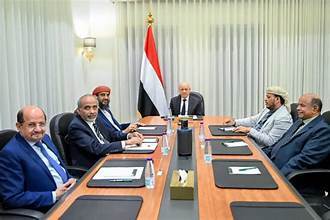
The visit of a European Parliament delegation to Yemen, and the messages delivered by al-Alimi during those discussions, reflect this approach.
Rather than limiting its appeals to humanitarian assistance or economic support, the government is seeking to present itself as a partner in protecting regional and international order: safeguarding Red Sea security, combating terrorism, countering smuggling and organized crime, curbing irregular migration, and protecting global supply chains.
In doing so, it is attempting to redefine international support for the government as a matter of shared security interests, rather than merely a political commitment to an internationally recognized authority.
Iran at the Heart of the Equation
This shift cannot be separated from the Iranian dimension.
The Yemeni government has consistently sought to place the conflict within a broader framework linking Houthi military capabilities to Iranian support, arguing that the group’s continued possession of missiles, drones, and maritime capabilities makes Yemen part of a regional network of influence extending beyond its domestic political dynamics.
The significance of this argument, however, lies not only in Iran itself, but also in the way it frames the conflict for international audiences.
When the government presents the Houthi threat primarily as an extension of an internal conflict, the issue remains largely tied to Yemen’s peace process. But when it links that threat to Red Sea security, international shipping, and Iranian regional influence, the circle of stakeholders expands to include the United States, Europe, the Gulf states, Red Sea littoral countries, and major trading powers dependent on the maritime route.
Nevertheless, reducing Yemen’s crisis solely to the Iranian dimension carries analytical risks.
Over the course of the war, the Houthis have developed into a significant domestic actor with their own political, military, and social base, even while benefiting from Iranian support. Treating the group simply as an external proxy risks producing an incomplete understanding of the conflict, just as ignoring its regional connections would underestimate the sources of its military strength and resilience.
A sustainable solution must therefore address both dimensions simultaneously: the conflict’s domestic roots and the regional dynamics that have fueled it and transformed Yemen into an arena of broader geopolitical competition.
Airspace Sovereignty: A Microcosm of a Larger Struggle
The dispute over flights from Sana’a offers a microcosm of this wider dilemma.
On the surface, the issue is straightforwardly humanitarian: Yemenis have a legitimate need to travel, particularly millions living in Houthi-controlled areas under extremely difficult conditions.
Politically, however, the issue raises a more complicated question: Who has the sovereign authority to manage airspace, airports, and international flights?
The government argues that allowing arrangements outside its institutions could gradually entrench a parallel authority exercising state-like functions. The Houthis, meanwhile, can use the population’s humanitarian need for travel to reinforce an administrative and political reality independent of the internationally recognized government.
This explains why the government’s support for the Jordanian initiative to resume flights between Sana’a and Amman has been accompanied by a clear condition: humanitarian needs should be addressed within a legal framework that preserves the state’s sovereign authority.
The issue illustrates one of the most difficult challenges facing any future Yemeni settlement: How can the suffering of civilians in Houthi-controlled areas be alleviated without allowing humanitarian measures to contribute to the gradual institutionalization of a divided state?
The dilemma extends well beyond aviation. It also affects ports, banks, currencies, salaries, telecommunications, and revenues from oil and gas.
Military Moves: Deterrence or Improving Negotiating Leverage?
Alongside its political outreach, government-aligned forces have sought to demonstrate military readiness along the western coast, including announcements that they had thwarted Houthi maritime movements near Zuqar Island and repelled attempted advances on fronts in Hodeidah.
These developments carry significance beyond their immediate military value.
In protracted conflicts, negotiations cannot be separated from the balance of power. Each party seeks to preserve—or improve—its military position before entering any potential settlement.
For the government, demonstrating an ability to protect parts of the coastline and surrounding maritime routes serves two purposes. The first is military: preventing the Houthis from expanding their influence. The second is political: demonstrating that forces aligned with the internationally recognized authorities can serve as an effective partner in protecting the Red Sea.
This approach, however, faces a structural challenge: the multiplicity of armed forces within the anti-Houthi camp.
Restoring the state requires more than confronting the Houthis. It also requires unifying the various military and security formations associated with different factions represented within or aligned with the Presidential Leadership Council.
This creates an important paradox. The government demands that the Houthis relinquish their weapons to the state, while simultaneously facing the challenge of demonstrating that it can unify the armed forces within its own camp under a single institutional national command.
Until that issue is addressed, the principle of a “state monopoly over arms” will remain more complex than a demand directed solely at the Houthis.
The Economy: The Weakest Link in the Legitimacy Equation
Despite the focus on security and the Red Sea, the economy remains perhaps the greatest threat to the government’s ability to strengthen its position.
Any project aimed at restoring the state requires institutions capable of paying salaries, providing electricity and basic services, stabilizing the currency and prices, and effectively managing ports and national resources.
Government directives to tighten market oversight, protect strategic facilities and ports, combat smuggling and corruption, and maintain essential services are therefore not separate from the political conflict; they lie at its core.
In prolonged civil wars, state legitimacy is not measured by international recognition alone. It is also measured by the state’s ability to provide services, manage the economy, and enforce the law.
This poses a particular challenge for the Yemeni government.
While it can mobilize substantial international support as the recognized authority, its ability to convert that recognition into domestic legitimacy depends heavily on whether living conditions improve in areas under its control.
Saudi economic and humanitarian assistance is therefore important beyond its immediate financial value, as it helps sustain the functioning of government institutions. At the same time, continued dependence on external assistance underscores the need for a more sustainable economic model that reduces the state’s reliance on foreign support.
Can the European Union Change the Equation?
The government’s decision to deliver these messages to a European Parliament delegation is more than a matter of diplomatic protocol.
Europe is among the regions most directly affected by disruption in the Red Sea, as the maritime route through Bab al-Mandab and the Suez Canal is a critical artery for trade between Europe and Asia.
The Yemeni government is therefore seeking to convert European concerns over maritime disruption into stronger political, economic, and security support for state institutions.
Yet the European Union’s ability to alter the balance remains limited.
Europe can provide humanitarian and development assistance, support institution-building, exert diplomatic pressure, and contribute to maritime security. It cannot, however, impose a political settlement inside Yemen or independently transform the military balance of power.
The European role is therefore likely to be most effective when integrated into a broader framework involving the United Nations, Gulf states—particularly Saudi Arabia and Oman—and other influential international powers.
The challenge is to strike a difficult balance between two objectives: pressuring the Houthis over threats to maritime navigation and other violations, while simultaneously preserving diplomatic channels capable of preventing a return to full-scale war.
A New Equation for Peace
Yemen now faces a fundamentally different equation from the one that prevailed during the early years of the war.
The question is no longer simply how to stop the fighting between the government and the Houthis. It is how to construct a settlement that prevents Yemen from becoming a permanent source of regional instability and a recurring threat to international maritime navigation.
Any future peace process will therefore have to address issues that can no longer be postponed: the structure of the state, the future of heavy weapons, control over missiles and drones, management of ports and airports, security of coastlines and islands, distribution of national resources, and the unification of military and economic institutions.
Yet linking peace in Yemen to Red Sea security presents both an opportunity and a risk.
The opportunity is that it brings Yemen back to the center of international attention and gives the international community a direct interest in building a stable state capable of securing its coastline and institutions.
The risk is that Yemen could come to be viewed primarily as a “maritime security file,” with the protection of ships and commercial routes overshadowing the domestic roots of the crisis, the suffering of Yemenis, and the requirements of rebuilding the state.
The more sustainable approach, therefore, is not to choose between domestic peace and Red Sea security, but to recognize that the two have become inseparable.
There can be no lasting security for maritime navigation without a stable Yemeni state possessing institutions capable of enforcing the law and exercising effective authority over its territory and coastline. Conversely, no stable state can emerge if Yemen remains an open arena for regional rivalry, weapons proliferation, and competing centers of power.
The most important message emerging from Yemen’s latest political and military moves therefore goes beyond diplomatic meetings, official statements, and battlefield developments: Red Sea security ultimately begins with the kind of state that emerges from Yemen’s war.
Whether the Yemeni government can turn this proposition into an international strategy that strengthens its position will depend on its ability to demonstrate two things simultaneously: that it can be a credible partner in safeguarding regional security, and that it can build a more effective and cohesive model of governance at home.
The struggle over Yemen’s future will therefore not be decided solely on the battlefield or at the negotiating table. It will also depend on the answer to a more fundamental question: Can the Yemeni state restore its ability to govern the strategic geography that, despite the country’s internal crises, makes Yemen one of the central pillars of Red Sea security?
Most read



Read also