Why Is the “Day After” Process in Gaza Stalling?

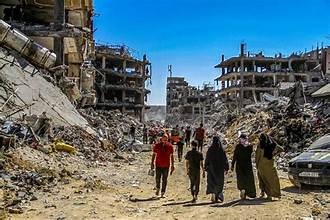
The crisis in Gaza is no longer centered solely on a ceasefire or the delivery of humanitarian aid. Increasingly, it revolves around a far more complex question: how can the transition from war to a new political and security order take place without first resolving the fate of Palestinian armed factions’ weapons? Months after the announcement of the so-called “Trump Plan” aimed at ending the war and restructuring governance in Gaza, the initiative appears to be gradually losing momentum as the gap widens between the American-Israeli vision and the calculations of Hamas and other armed groups.
From the outset, the plan was never merely a proposal to halt hostilities. Rather, it represented a broader project to politically and institutionally redesign Gaza. It was presented as a multi-stage process beginning with a ceasefire and prisoner exchanges, followed by reconstruction and governance arrangements, ultimately leading to the transfer of administrative authority to the Palestinian Authority within a framework that would, in theory, pave the way for a broader political settlement. Beneath this formula, however, it was evident that the core objective was the gradual elimination of Hamas’s military and political role and the reconfiguration of the balance of power within the Gaza Strip.
What appeared on paper as a structured political transition quickly collided with a far more complicated reality on the ground. Israel and the United States treated Hamas’s disarmament as the central prerequisite for moving to the next phase, while Hamas viewed any discussion of relinquishing its weapons before the fulfillment of Israeli commitments and the emergence of a credible political horizon as effectively surrendering its leverage without meaningful guarantees. As a result, the issue of disarmament evolved from one component of the plan into the principal obstacle threatening its entire viability.
The dilemma has become even more complicated due to the continuation of Israeli military operations in Gaza, the absence of any substantial improvement in humanitarian conditions, the slow pace of reconstruction, and the failure of alternative governance structures envisioned for the post-war period to materialize. From Hamas’s perspective, the process does not resemble a transition toward a political settlement as much as an attempt to impose a new security reality through military and economic pressure.
At a deeper level, Hamas understands that its weapons are not merely military tools but a fundamental source of influence and legitimacy within the Palestinian political system. For decades, the standing of Palestinian factions has been closely tied to their ability to combine political participation with armed capability. Consequently, any complete abandonment of weapons prior to a final settlement remains highly sensitive within Hamas’s organizational and ideological framework.
Moreover, Israel’s continued targeting of Hamas leaders—including figures often viewed within the movement as relatively pragmatic—has strengthened the influence of more hardline currents. These factions argue that early concessions on the issue of weapons would not lead to peace but rather weaken the movement and pave the way for arrangements imposed by force.
On the other side, Israel remains firmly committed to the logic of “complete security resolution.” Israeli policymakers view any arrangement that allows Palestinian factions to retain even a limited military capability as merely postponing a future threat rather than eliminating it. Consequently, Israel has pushed for an interpretation of the plan that makes immediate and comprehensive disarmament a prerequisite for withdrawal, reconstruction, and any subsequent political transition.
Yet this Israeli position contains an inherent paradox. The greater the pressure to disarm without a corresponding political framework, the stronger the conviction among Palestinian factions that retaining weapons is their only remaining guarantee. In this sense, the crisis extends far beyond disagreements over security arrangements and becomes, fundamentally, a crisis of trust between all parties involved.
As a result, discussions have emerged within some Palestinian circles regarding a phased approach to disarmament. Such proposals envision placing heavy weapons under international supervision and preventing their operational use while simultaneously implementing a gradual Israeli withdrawal, launching reconstruction efforts, and opening a broader political process. This approach reflects growing recognition that any attempt to impose immediate and total disarmament could simply lead to the collapse of the ceasefire and the resumption of hostilities, particularly given the fragmented and complex reality within Gaza and the presence of factions that may reject such arrangements altogether.
In this context, several regional actors—most notably Egypt, Qatar, and Turkey—appear increasingly inclined toward a gradual strategy based on the “containment” rather than the immediate elimination of weapons. At the same time, some European policymakers have begun to acknowledge that long-term stability in Gaza cannot be achieved through security measures alone, but requires a genuine political process capable of addressing the deeper roots of the Palestinian-Israeli conflict.
The central problem, however, remains the absence of a clear international vision for the “day after” in Gaza. Israel seeks a demilitarized territory governed under strict security arrangements. Hamas, meanwhile, aims to preserve at least a minimum level of military and political capability. The United States seeks to prevent the collapse of the broader framework while showing limited willingness to pressure Israel into making substantial political concessions. Amid these competing objectives, Gaza appears likely to enter a prolonged period characterized by temporary ceasefires, limited reconstruction, and partial security understandings, without achieving a comprehensive settlement capable of addressing the underlying causes of conflict.
Such a scenario carries significant risks. It preserves the structural conditions that fuel instability and ensures that any security incident or political breakdown could reignite large-scale violence. It also entrenches a reality in which Gaza remains suspended between war and peace—neither fully stable nor entirely removed from the cycle of conflict.
Ultimately, the disarmament debate in Gaza reveals that the central question is no longer merely the future of Hamas but the future of the Palestinian political project itself. Historical experience suggests that disarmament rarely succeeds when imposed as a precondition for peace; rather, it is more likely to succeed as the outcome of a political process that provides all parties with a sense of security, recognition, and meaningful participation in a stable political order. For this reason, any effort to establish lasting stability in Gaza will remain contingent upon the ability of regional and international actors to move beyond the logic of “crisis management” toward a strategy focused on addressing the root causes of the conflict—making security the product of peace, rather than its substitute.
Most read



Read also