Westminster Between the Erosion of Parliamentary Oversight and the Rise of the Executive State

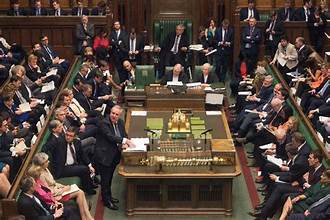
British political life has witnessed, in recent years, a gradual transformation in the relationship between government and Parliament—a transformation that no longer concerns merely procedural disputes within the House of Commons of the United Kingdom, but increasingly reflects a deeper crisis regarding the nature of governance and the mechanisms of decision-making within the British state itself. Under the Labour Party government led by Keir Starmer, there are growing indications of the expanding influence of the executive branch—symbolized by “Whitehall”—at the expense of Parliament’s traditional role as the principal arena for accountability and political scrutiny.
This shift became particularly visible during the recent parliamentary recess, when the government continued announcing economic and trade policies through press conferences and media briefings while Parliament itself remained largely absent from the practical process of decision-making. Although parliamentary recesses are a normal part of the British political system, the real issue was not the suspension of legislative sessions as such, but rather the manner in which public policy increasingly appears to be managed outside traditional parliamentary frameworks.
The controversy was exemplified by the criticism voiced by Speaker of the House Sir Lindsay Hoyle, who rebuked the government for announcing economic policies through the media before presenting them formally before Members of Parliament. His criticism was not simply a defense of parliamentary procedure; it reflected growing concern within the legislative institution itself over the marginalization of Parliament in favor of a more centralized and tightly managed political and media apparatus.
The Rise of “Image Politics” at the Expense of Parliamentary Debate
The Starmer government has demonstrated a clear tendency toward governing through modern mass communication tools: carefully choreographed press conferences, calculated leaks, tightly managed media briefings, and a strong emphasis on controlling the political narrative and shaping the government’s public image. As a result, British politics has increasingly resembled a model of “media-managed governance,” in which control over timing and messaging sometimes takes precedence over traditional parliamentary transparency.
This trend does not represent a complete break with British political traditions. The tension between Whitehall and Westminster is deeply rooted in the structure of the British political system itself. The executive branch naturally favors speed, efficiency, and minimizing political obstruction, whereas Parliament’s core role has always been to scrutinize, question, and slow decision-making sufficiently to allow for public debate.
What is different today, however, is that modern media tools and the logic of rapid political communication have given governments unprecedented ability to bypass Parliament in practice without formally diminishing its constitutional status. Parliament legally remains the center of sovereignty and legislation, yet the daily management of politics increasingly occurs within media and communication spaces outside the chamber of the House of Commons.
The Gulf Trade Agreement as a Model of Extra-Parliamentary Governance
The Starmer government’s handling of the free trade agreement with the Gulf Cooperation Council provided a striking example of this transformation. Despite the agreement’s significance as one of Britain’s largest trade deals since Brexit—and despite expectations that it would contribute billions of pounds to the British economy—the manner of its announcement revealed the prioritization of media management over parliamentary engagement.
The government carefully controlled the timing of the announcement, withholding key details from direct parliamentary discussion until the final moment. This reinforced the growing perception that the executive branch increasingly views Parliament not as the primary arena for deliberation and policymaking, but rather as a secondary platform for ratification and justification.
The Deeper Crisis: A Growing Trust Gap Within British Society
Yet the issue extends beyond institutional balances; it also reflects a widening crisis of trust within British society itself. While the government highlights growth indicators, investment flows, and new trade agreements, large segments of the British public increasingly feel that their daily reality points in the opposite direction.
Rising public debt, expanding government borrowing, deteriorating public services, and mounting living costs have all contributed to a widening divide between an “official Britain” that speaks the language of markets, growth, and investment, and an “everyday Britain” struggling with escalating economic and social pressures.
In this context, the weakening of Parliament’s role becomes even more dangerous, because Parliament historically functioned not merely as a legislative institution but also as a mechanism linking public sentiment to political decision-making. The more this role declines in favor of media-driven governance, the stronger the perception among citizens that ruling elites are managing the state from above, detached from direct public accountability.
Toward a Redefinition of the Relationship Between State and Society
Current developments in Britain reflect broader transformations occurring across Western democracies, where traditional parliamentary politics is increasingly giving way to the rise of the “executive state,” empowered by modern media systems, data management, and narrative control.
Yet the continuation of this trajectory carries significant long-term risks, foremost among them the erosion of trust in representative institutions and the strengthening of populist movements that present themselves as the authentic voice of “real society” against political and administrative elites.
For this reason, the greatest challenge facing the Starmer government is not merely improving economic indicators or signing new trade agreements. Rather, it lies in restoring the balance between executive efficiency and democratic legitimacy, and between the demands of governing a modern state and preserving Parliament’s historic role as the political heart of the British constitutional system.
Most read