
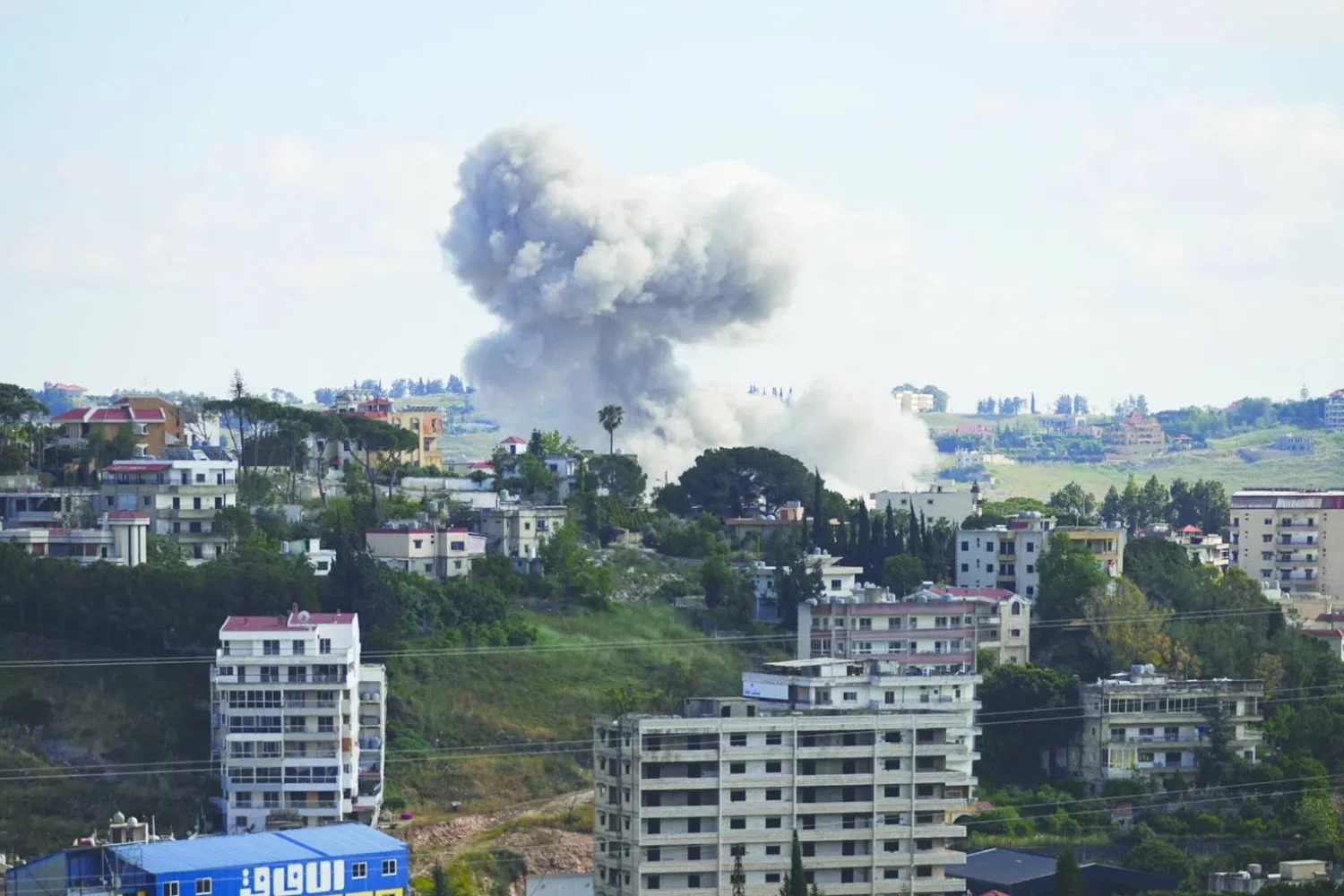
The newly proposed U.S.-brokered framework between Lebanon and Israel appears to extend far beyond a technical arrangement governing Israeli withdrawal from Lebanese territory or consolidating a ceasefire. Rather, it reflects an attempt to redefine the relationship between Lebanese sovereignty and Hezbollah’s military capabilities within a new political and security equation. The debate unfolding inside Lebanon is therefore not confined to the content of the agreement itself; it encompasses the legal and political foundations upon which it rests, and whether it constitutes a pathway toward restoring full state sovereignty or instead inaugurates a phase in which the exercise of sovereignty becomes contingent upon a series of security obligations largely shaped by Israel and its international partners.
Against this backdrop, Lebanese political and diplomatic circles have offered sharply divergent interpretations. While some view the framework as an opportunity to end a prolonged state of conflict and pave the way for reconstruction, others argue that it fundamentally transforms the concept of sovereignty by redefining the relationship between the Lebanese state and the armed resistance according to externally imposed conditions rather than domestically negotiated arrangements.
From International Legitimacy to Conditional Legitimacy
One of the most notable criticisms of the framework has come from a Lebanese diplomatic source who supports negotiations with Israel and upholds the principle that the Lebanese state should remain the sole authority responsible for conducting negotiations. Nevertheless, the source argues that the proposed framework departs significantly from the traditional foundations of international law.
According to this interpretation, the agreement is no longer based on the unconditional implementation of international legal obligations requiring the end of occupation. Instead, it establishes a new formula whereby Israeli commitments become dependent upon Lebanon first fulfilling an extensive list of security and administrative requirements. Consequently, ending the occupation is transformed from a legal entitlement into a political outcome contingent upon Lebanon's compliance with predetermined conditions.
Critics argue that the framework links every stage of Israeli withdrawal to a comprehensive package of Lebanese obligations, including the disarmament of all armed groups, the dismantling of their military infrastructure, tighter border controls, the disruption of financial networks, comprehensive security-sector reforms, the establishment of international monitoring mechanisms, and the conditioning of economic assistance upon verified implementation of these measures.
From this perspective, the arrangement effectively grants Israel the ability to suspend its own obligations whenever it concludes that Lebanon has failed to meet the required benchmarks. In practical terms, Hezbollah's continued possession of weapons becomes both the justification for maintaining Israeli forces in disputed areas and the principal obstacle to completing the withdrawal process.
Redefining the Meaning of Sovereignty
The proposed framework reveals a deeper transformation concerning the very meaning of sovereignty. Rather than treating sovereignty as an inherent right guaranteed under international law, it increasingly becomes a phased process dependent upon fulfilling a series of externally supervised security commitments.
This evolution carries significant political implications. On one hand, the Lebanese state is expected to restore its exclusive monopoly over the legitimate use of force throughout its territory. On the other hand, it must demonstrate its capacity to implement highly sensitive security obligations within an exceptionally complex political and sectarian environment.
Moreover, linking reconstruction funding and international financial assistance to the fulfillment of these commitments provides external actors with additional leverage over Lebanese decision-making. As a result, economic recovery becomes integrated into the broader security architecture rather than functioning solely as a humanitarian or developmental objective.
Hezbollah Between Deterrence and Domestic Pressures
Hezbollah's response to the framework has been characterized by notable caution. Despite employing strong rhetoric to criticize aspects of the proposal, the movement refrained from organizing large-scale public demonstrations, while the Lebanese Army acted swiftly to disperse limited gatherings described as spontaneous expressions of support by the party's followers.
This restrained posture reflects Hezbollah's recognition of Lebanon's fragile domestic environment. The country's prolonged economic crisis, widespread social exhaustion, and political fragmentation significantly increase the potential costs of any internal confrontation.
At the same time, Hezbollah officials have consistently emphasized that the proposed framework does not fundamentally alter the regional balance of power, warning political opponents against interpreting the U.S.-sponsored initiative as evidence of the party's strategic decline or the erosion of the deterrence equation it has cultivated over the past two decades.
Party representatives have also announced that Hezbollah, in coordination with its ally the Amal Movement, will conduct a comprehensive assessment of the emerging political landscape before determining its future course of action. This suggests that the current period is less one of immediate confrontation than of strategic recalibration and careful observation of how implementation unfolds.
The Strategic Dilemma Facing Hezbollah
The framework presents Hezbollah with one of the most consequential strategic dilemmas in its history. Retaining its military capabilities would likely prolong international pressure, sustain Israeli security concerns, and potentially delay the full withdrawal of Israeli forces. Conversely, relinquishing those capabilities would extend far beyond military considerations, fundamentally reshaping Lebanon's internal balance of power while affecting the broader regional network of influence in which Hezbollah remains a central actor.
Meanwhile, the option of returning to sustained military confrontation appears increasingly costly. Israel's overwhelming advantages in intelligence, surveillance, precision strike capabilities, and airpower significantly raise the risks associated with any prolonged conflict. Another war would almost certainly deepen Lebanon's humanitarian crisis, accelerate economic collapse, prolong the displacement of civilians, and increase the country's dependence on international assistance.
Accordingly, Hezbollah's strategic choices appear constrained by an exceptionally complex equation. Major concessions remain difficult without credible political guarantees, yet maintaining an open-ended confrontation has become equally difficult under Lebanon's current domestic circumstances.
Public Priorities: Return Before Politics
Despite the intensity of political debate, public sentiment inside Lebanon appears increasingly driven by humanitarian and economic concerns rather than constitutional or legal controversies. For thousands of displaced families, returning safely to their homes and initiating reconstruction efforts constitute the most immediate priorities.
This reality helps explain the relatively limited popular mobilization against the framework thus far. Should Israeli withdrawals begin in a tangible and verifiable manner, many observers expect public criticism to diminish as national attention shifts from the political content of the agreement toward its practical outcomes, particularly if withdrawal is accompanied by the return of displaced residents and meaningful reconstruction efforts.
Nevertheless, such a scenario will ultimately depend upon all parties honoring their respective commitments and upon the Lebanese state's ability to manage the transition without triggering internal political confrontation or renewed military escalation with Israel.
Conclusion
The debate surrounding the U.S.-brokered framework demonstrates that Lebanon's current crisis extends well beyond the issues of ending Israeli occupation or maintaining a ceasefire. At its core lies a broader struggle over the nature of the Lebanese state itself, the limits of its sovereignty, and the future relationship between state institutions and non-state armed actors.
While supporters regard the framework as a historic opportunity to restore state authority and consolidate national sovereignty, critics view it as a mechanism that renders sovereignty conditional upon externally defined security requirements. Ultimately, the agreement's long-term viability will depend not merely on whether Israeli withdrawals commence, but on whether the framework can achieve a sustainable balance between legitimate security concerns, the principles of international law, and the intricate realities of Lebanon's political system. Only under such conditions can the process contribute to lasting stability without reinforcing internal divisions or perpetuating the uncertainty that has defined Lebanon's modern political landscape.
Most read



Read also