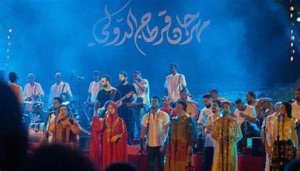

Songs do not live only within concert halls; they live within the everyday memory of people. They accompany them through travel, work, weddings, sorrow, and longing, gradually becoming part of both their personal and collective history.
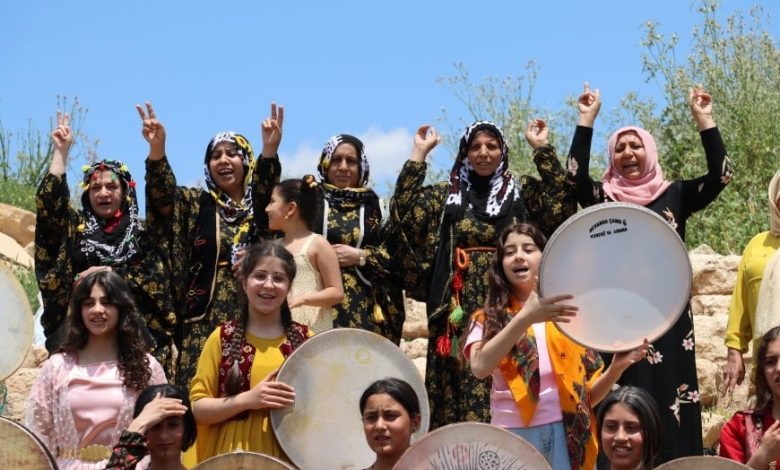
For this reason, folk songs among Arabs and Kurds are not merely passing forms of art, but rather a long archive of emotions, experiences, and stories that societies have carried through the years.
Among the cultural dimensions highlighted by the “Takamul… Arabs and Kurds… A Shared Destiny” campaign, affiliated with the International Istishraf Network, was the folk song as a human space that brings peoples together far more than it divides them.
People may differ politically, but they are often remarkably similar in longing, love, fear, and hope—and all these emotions inhabit songs before anything else.
Anyone who reflects on Kurdish and Arab songs will quickly notice the deep intersection in spirit and feeling: that long Eastern melancholy, the attachment to the land, and the powerful presence of themes such as absence, waiting, dignity, and loyalty—all recurring prominently in both traditions.
Even the style of singing itself carries profound closeness: the voice emerging as though it bears an entire history of fatigue and longing, and rhythms inclined more toward beautiful sadness than toward loud, hurried excitement.
Perhaps for this reason, many Arabs feel emotionally close to Kurdish songs even when they do not fully understand the words, because feeling always precedes language.
At the same time, Arabic songs have long held a strong presence within Kurdish society, whether through classical Arabic music, folk songs, or even modern songs that traveled easily across communities due to geographical proximity and cultural interaction.
For decades, the region exchanged music and melodies naturally, until some songs became part of a shared collective memory transcending borders and narrow identities.
This is precisely what the “Takamul” campaign sought to remind people of: that art—and especially music—possesses a unique ability to build bridges between people because it speaks to the most human part within them.
In recent years, social media has played a significant role in rediscovering this artistic closeness. Many Kurdish musical clips have begun circulating widely within Arab digital spaces, and vice versa, creating a mutual cultural curiosity among younger generations.
It is also encouraging that many Arab and Kurdish artists have attempted, in different ways, to produce collaborative works or reinterpret traditional songs with a modern spirit—an effort that reflects an implicit desire to keep the space of art open for dialogue and rapprochement.
True art does not thrive behind closed walls. Folk songs in particular possess a unique value because they emerge directly from the people themselves, not from official institutions or political rhetoric. They are the voice of daily life, with all its fatigue, joy, and waiting.
For this reason, songs are sometimes more capable of preserving the memory of peoples than books or speeches. And in a region that has endured years of crises and divisions, returning to art may seem simple, but in reality it is an attempt to recover the human dimension that has receded under the weight of politics and conflict.
When a person hears a song that resembles their sorrow or joy, they instinctively feel that the other is not as distant as they once imagined. Perhaps this is why music remains one of the last spaces where peoples can still meet without fear or preconditions—because songs, in the end, preserve not only words, but people as well.
Translated from Al Arabi Elyoum:
Al Arabi Elyoum
Most read