India’s Hypersonic Breakthrough Comes as China and Pakistan Tighten Strategic Pressure in the Indian Ocean

By Gabriel Honrada
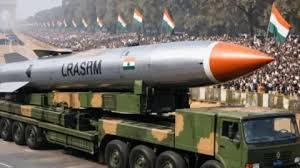
India’s decision to publicly unveil a long-range hypersonic anti-ship missile reflects a broader shift in its maritime strategy, as it faces mounting pressure from the expansion of the Chinese navy and the modernization of Pakistan’s naval capabilities in the Indian Ocean. This month, multiple media outlets reported that India showcased its Long-Range Anti-Ship Missile (LR-AShM) for the first time during the 77th Republic Day parade along Kartavya Path—marking a major leap in India’s naval strike capabilities.
Developed domestically by the Defence Research and Development Organisation, the missile is designed to strike targets at distances of up to approximately 1,500 kilometers.
The LR-AShM uses a two-stage solid-fuel propulsion system, enabling it to reach peak speeds of up to Mach 10, while sustaining an average speed of around Mach 5 along a quasi-ballistic trajectory involving multiple atmospheric “skips.” This low-altitude maneuvering profile is specifically engineered to evade conventional ship-based radar systems and drastically shorten enemy decision-making time.
A successful validation test conducted in November 2024 at Dr. A. P. J. Abdul Kalam Island confirmed the missile’s ability to perform precise terminal maneuvers against moving maritime targets. Strategically, the LR-AShM places India alongside a small group of states—including the United States, Russia, and China—that possess hypersonic anti-ship weapons.
The missile is expected to reach full operational deployment within two to three years and was originally designed for coastal battery deployment. It supports a land-based launch doctrine from fixed or mobile platforms, including bases in the Andaman Islands, allowing India to target high-value assets such as aircraft carriers before they become operational threats. It can also be integrated into opening strike packages alongside submarines and surface vessels armed with BrahMos missiles to conduct layered attacks.
Growing Maritime Pressures
China’s expanding naval footprint in the Indian Ocean, coupled with the modernization of the navy of Pakistan, presents a dual strategic challenge for India. These trends threaten India’s sea lines of communication and risk extending regional land conflicts into the maritime domain.
Highlighting the rapid growth of the Chinese navy, analysts Prashant Hosur Suhas and Christopher Colley noted in a May 2024 article that China’s fleet—now the world’s largest by number of vessels—stands in stark contrast to the much slower pace of Indian naval modernization.
A 2024 report by the United States Department of Defense stated that China possessed more than 370 ships and submarines at the time of publication, with projections rising to 395 vessels by 2025 and 435 by 2030, according to a follow-up assessment by the Congressional Research Service in April 2025.
By comparison, analyst James Fanell wrote in December 2025 that India operates roughly 150 warships, with plans to expand its fleet to 230 vessels by 2027. This disparity could enable China to conduct simultaneous operations in both the Pacific and Indian Oceans, reducing the need to shift forces between theaters.
Dual-Use Infrastructure and Strategic Encirclement
While the absence of permanent Chinese military bases in the Indian Ocean was once seen as a limiting factor, analyst Darshana Baruah notes that China has conducted multiple naval exercises in the region and invested heavily in dual-use port infrastructure in countries neighboring India. Though primarily commercial in nature, these facilities could be adapted for military use in times of crisis.
China has also played a central role in modernizing Pakistan’s navy. According to Syed Fazl-e-Haider, Beijing has supplied Islamabad with advanced frigates, submarines, and combat aircraft—moves that could enable Pakistan to dominate key maritime corridors through which China’s oil imports pass. Together, these developments heighten the risk of strategic encirclement of India, stretching from the Himalayas and Kashmir to the Indian Ocean.
From Fleet Size to Precision Deterrence
Confronted with unfavorable naval balance, India appears to be recalibrating its maritime doctrine. Rather than relying primarily on fleet size or forward deployment, it is increasingly emphasizing a technology-driven anti-access/area denial (A2/AD) approach—centered on long-range, land-based precision strikes to offset the numerical and geographic advantages of China and Pakistan.
This marks a shift from platform-centric sea control to effect-based deterrence, where long-range firepower substitutes for fleet mass. In this framework, a hypersonic anti-ship missile like the LR-AShM could significantly tilt the military balance in India’s favor.
Analyst Tahir Azad argues that both the Russia–Ukraine war and the Israel–Iran conflict of July 2025 demonstrated that the future of deterrence lies in hypersonic weapons. Conventional missiles are increasingly vulnerable to preemptive strikes and interception, whereas hypersonic systems remain extremely difficult for current defenses to counter.
India’s A2/AD strategy may mirror China’s approach in the western Pacific, which relies on long-range anti-ship ballistic missiles to deter US carrier strike groups. Similarly, the LR-AShM provides India with a land-based capability to strike high-value naval assets, allowing friendly forces to operate under its deterrent umbrella.
Risks of Escalation
Strategically, the missile could strengthen India’s conventional deterrence against both China and Pakistan by raising the cost of maritime coercion. However, adversaries may respond by enhancing layered carrier defenses, expanding dual-use infrastructure in the Indian Ocean, or transferring more advanced weaponry to Pakistan.
Security analyst Nitya Labh warns that long-range missile testing in the Indian Ocean creates “dual-use ambiguity,” making it difficult to distinguish between conventional and nuclear intent. In a crowded maritime theater involving Chinese surveillance ships and multiple nuclear-armed states, this ambiguity heightens the risk of miscalculation and rapid escalation. Without robust crisis-management mechanisms, such dual-capable systems may amplify instability rather than reinforce deterrence.
Conclusion
Overall, the LR-AShM significantly strengthens India’s maritime deterrence and partially offsets unfavorable naval power dynamics in the Indian Ocean. Yet its stabilizing impact will depend on India’s ability to manage escalation risks, maintain signaling discipline, and enhance crisis-control mechanisms within an increasingly congested and nuclear-shadowed maritime environment.
Source: Asia Times
Most read