
How Is Artificial Intelligence Reshaping the Defense Industry?

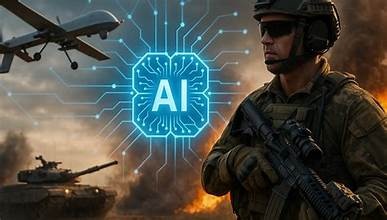
Artificial intelligence is no longer merely a technological advancement added to conventional military tools. It has become one of the most influential forces redefining the concept of military power in the twenty-first century. Just as the Industrial Revolution transformed the structure of armies, and the digital revolution reshaped command, control, and intelligence systems, AI now appears poised to trigger an even deeper transformation—one that touches the very relationship between humans and machines, and between military decision-making and combat capability. Power is no longer measured solely by the possession of weapons, but increasingly by possession of the intelligence that operates them, the data that feeds them, and the algorithms that provide speed, precision, and predictive advantage.
Although global debate around military AI has expanded significantly—particularly concerning autonomous weapons systems and ethical concerns—one equally important dimension still receives less attention: the ongoing transformation of the defense industrial base itself. The real shift is not occurring only on battlefields, but inside corporations, data centers, investment networks, and software laboratories, where the tools of future military power are being built. Understanding the future of international security therefore also requires understanding who develops these technologies and who controls their industrial foundations.
Throughout much of the twentieth century, the state was the primary engine of military innovation. Ministries of defense, military research institutions, and traditional arms manufacturers together formed what became known as the military-industrial complex. Armed forces defined their operational requirements, and companies designed systems to meet those needs through long cycles of procurement, production, and development. Artificial intelligence, however, has gradually disrupted this model. Many of the most significant innovations in AI did not emerge from military institutions, but from the civilian private sector—especially technology companies that pioneered cloud computing, big data analytics, machine learning, and advanced language models. As a result, states increasingly seek to adapt innovations produced by the market rather than generating them independently.
This shift reflects a deeper reality: the military AI industry is not a separate, clearly bounded sector. Rather, it is a complex network in which multiple layers intersect. At the foundation are firms producing semiconductors, operating data centers, and providing cloud infrastructure necessary to run advanced models. Above them are companies developing foundational AI systems capable of analysis, prediction, and interaction. At the top are companies transforming these capabilities into direct military applications such as command-and-control systems, drones, satellite imagery analysis, and battlefield management tools. In this sense, future military power is not created by one actor alone, but by an interconnected ecosystem of industrial players.
Within this landscape, major technology corporations have emerged as strategic actors that cannot be ignored. Companies such as Microsoft, Google, and Amazon are no longer simply civilian service providers. They increasingly control the digital infrastructure upon which modern militaries depend. The ability to manage data, secure networks, and provide cloud computing has become nearly as important as manufacturing tanks or aircraft. Consequently, military influence in the future may often be exercised through digital platforms and server architecture as much as through bases and factories.
At the same time, a new wave of defense startups has emerged, operating according to a logic very different from that of traditional defense contractors. Rather than waiting for long and complicated government procurement cycles, these firms develop products first and market them later to military customers. This model has enabled companies such as Palantir Technologies, Anduril Industries, and Shield AI to rise rapidly by offering battlefield management systems, data integration platforms, autonomous systems, and counter-drone solutions. Their strength lies not in factory scale or historical legacy, but in speed of innovation and the ability to convert software into combat capability within short timeframes.
This evolution is also transforming the traditional concept of the military-industrial complex. In the past, power was closely associated with firms capable of producing heavy platforms such as aircraft, warships, and missile systems. Today, however, strategic advantage may come from a small company that possesses a superior algorithm, a more accurate image-recognition model, or a faster system for integrating data and generating decisions. Intellectual capital is increasingly competing with industrial capital, and software now rivals steel and machinery at the center of military power.
Perhaps the most sensitive aspect of this transition is that private companies are no longer merely producing tools; they are beginning to influence military decision-making itself. AI systems used to support commanders, identify targets, or assess risks are built upon models and algorithms designed by private firms. This raises a profound strategic question: if algorithms shape decisions regarding the use of force, who truly controls the decision-making process—the military institution using the system, or the company that designed it? Any bias, technical flaw, or vulnerability embedded within these systems could escalate from a software issue into a national security crisis or a major operational failure.
This dynamic also carries a clear geopolitical dimension, particularly in the strategic competition between the United States and China. The United States benefits from a powerful innovation ecosystem combining leading universities, venture capital, technology giants, and defense institutions. China, by contrast, relies on a model based on centralized planning, state support, and close civil-military integration. Therefore, the military AI race is not simply about who possesses the best weapon, but about who possesses the industrial system most capable of rapid innovation, sustained production, and continuous adaptation.
As the role of corporations expands, legal and ethical challenges also intensify. These companies, regardless of their strategic importance, remain economic actors seeking profit, influence, and market expansion. Military decisions, however, involve life and death, sovereignty, and international humanitarian law. This creates difficult questions regarding accountability for autonomous system failures, transparency of algorithms, the right of firms to restrict military use of their technologies, and the risks posed by concentration of power in the hands of a small number of companies controlling key digital capabilities.
Ultimately, the world appears to be entering a phase in which power is being redistributed between states and corporations simultaneously. Future military strength will no longer be measured only by troop numbers, defense spending, or ownership of heavy combat platforms, but by control over data, computing capacity, and the industrial ecosystem capable of converting innovation into sustainable operational advantage. A state lacking an advanced technological and industrial base may therefore become strategically dependent on others—even if it fields a large military force.
The defining question of the coming years will not simply be who possesses the strongest army, but who possesses the system capable of generating power continuously. In this context, future balances of power may be shaped as much inside data centers and algorithmic laboratories as in factories and military barracks.
Most read




Read also