Hormuz Between Ceasefire and Escalation: Why Washington and Tehran Continue Testing Power Despite Diplomatic Talks

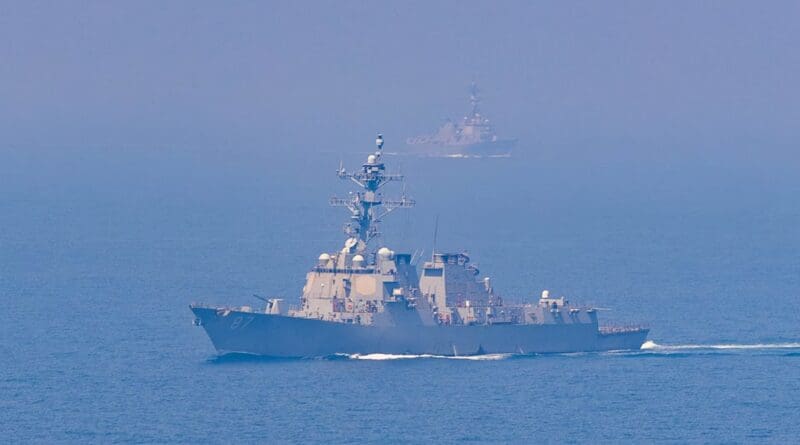
Despite growing talk of relative progress in political contacts between Washington and Tehran, the latest developments near the Strait of Hormuz reveal that de-escalation remains fragile and that the region has not truly moved beyond confrontation. The recent US strikes against Iranian targets and the interception of drones near the strait are not merely isolated military incidents; rather, they reflect the continuation of a broader “pressure management” battle in which each side seeks to improve its negotiating position without sliding into another full-scale war.
The Gulf appears to have entered a new phase of what could be described as “controlled confrontation” — a stage markedly different from the traditional patterns that have defined US-Iran tensions over the past decades. Instead of open war or complete calm, both sides are now managing the conflict through calibrated strikes, mutual deterrence messages, and carefully measured military moves, while keeping diplomatic channels indirectly active.
The Strait of Hormuz: More Than an Energy Corridor
The latest escalation cannot be understood without recognizing the strategic significance of the Strait of Hormuz, one of the world’s most critical maritime chokepoints. Roughly one-fifth of global oil trade passes through the strait each day, making it a vital artery not only for energy markets, but also for global trade routes, supply chains, and undersea communications infrastructure.
As a result, any security disruption in the area immediately affects oil prices, shipping and insurance markets, and the calculations of major powers dependent on Gulf energy flows, particularly China, India, Japan, and European states.
More importantly, the Strait of Hormuz is no longer merely a temporary leverage tool for Iran. It has gradually become part of a broader Iranian strategy aimed at redefining maritime influence and regional sovereignty. Tehran appears to be shifting from a policy of threatening closure toward one of “managed pressure and regulated disruption,” allowing it to maintain deterrence without triggering a large-scale naval confrontation whose costs could be enormous.
Why Is Washington Continuing Strikes Despite Ongoing Talks?
The recent US military actions carry multiple messages at a highly sensitive moment. On one level, Washington seeks to demonstrate that negotiations with Iran will not take place under the pressure of maritime threats or drone operations, and that the United States still retains the capacity to enforce military red lines in the Gulf.
On another level, the Biden administration — or more broadly the US political establishment — is attempting to reassure regional allies and international shipping companies that maritime security in the Strait remains under American protection, especially after criticism over what many viewed as declining US deterrence credibility in the region during recent months.
Limited strikes also provide Washington with a mechanism to apply pressure without completely collapsing diplomatic efforts. The US appears determined to keep escalation within manageable limits — enough to deny Iran strategic gains, but not enough to ignite an uncontrollable regional conflict.
In this context, the latest military operations can be understood as part of a broader strategy of balancing deterrence and diplomacy: using force tactically to strengthen negotiating leverage rather than eliminate the possibility of an agreement altogether.
Iran and the Strategy of “Flexible Resistance”
On the Iranian side, Tehran appears increasingly committed to what could be described as a strategy of “flexible resistance.” This approach is based on absorbing American pressure while preserving the ability to respond gradually and maintain regional maneuverability.
Iran understands that direct large-scale war with the United States could threaten the stability of the regime itself. Yet Tehran also recognizes that full retreat would weaken its regional standing and bargaining power. As a result, it relies on carefully calibrated escalation through drones, maritime operations, and indirect pressure tactics.
At the same time, Iran continues to exploit the geopolitical centrality of the Gulf, fully aware that the stability of the global economy remains deeply tied to secure maritime flows through the region.
Accordingly, Iranian drone deployments and naval maneuvers are not solely military instruments; they also serve as political messages aimed at reminding the international community that excluding Iran from regional security arrangements will leave the Strait permanently vulnerable to instability and uncertainty.
Pakistani Mediation and Shifting Regional Dynamics
One notable aspect of the current crisis is that negotiations between Washington and Tehran are no longer confined to traditional diplomatic channels. Regional mediators — including Pakistan — have become increasingly involved, reflecting a broader recognition among regional powers that a major conflict in the Gulf would have catastrophic consequences for the entire region.
At the same time, the regional environment itself has changed significantly compared to previous years. Gulf states appear increasingly cautious about the prospect of another large-scale war, while China has become more engaged in issues related to energy security and maritime stability, though without fully aligning with Washington’s confrontational approach.
Iran, meanwhile, appears eager to capitalize on these international shifts by presenting itself as an unavoidable actor in any future Gulf security arrangement.
The Gulf and the “Neither War nor Peace” Equation
Recent developments suggest that the region may be entering a prolonged phase of “neither war nor peace,” where limited military confrontations, economic pressure, and political tensions continue without reaching a decisive settlement.
This scenario carries serious risks, as it transforms the Gulf into a permanently unstable arena vulnerable to sudden escalation, especially amid the increasing militarization of maritime routes, the expanding role of drones, and the growing influence of unconventional actors in regional conflicts.
Sustained instability is also likely to increase shipping, insurance, and energy costs over time, with consequences extending far beyond the Middle East to the broader global economy.
Conclusion
The latest confrontation near the Strait of Hormuz demonstrates that the US-Iran conflict has entered a far more complex phase than a simple exchange of strikes and threats. Both sides are now attempting to redefine the rules of engagement in the Gulf by blending military pressure, political maneuvering, and indirect diplomacy.
While Washington seeks to preserve maritime deterrence and prevent Iran from imposing a new strategic reality in the Strait, Tehran aims to reinforce the idea that Gulf security can no longer be maintained without acknowledging Iran’s regional role and strategic interests.
Between these competing visions, the Strait of Hormuz is likely to remain one of the world’s most dangerous flashpoints — not only because it is an energy corridor, but because it has become a testing ground for the future shape of regional order and the limits of international influence in the Middle East.
Most read