Arab-Kurdish Markets Create a Shared Memory

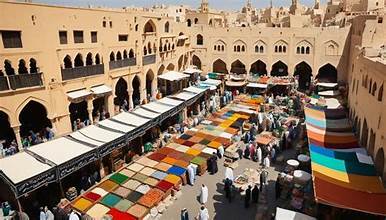
These markets were — and in many places still are — like a living fabric preserving the details of everyday life, while at the same time revealing deep layers of human coexistence that evolved over time بعيدًا from the noise of politics.
When a person enters an old market in a mixed city or an interconnected rural area, it quickly becomes clear that the place goes beyond the simple concept of buying and selling. There is a unique rhythm governing movement: the voices of vendors, the calls of customers, the smell of spices and fresh bread, and faces that have become accustomed to seeing one another every day until they themselves became part of the landscape.
In such an environment, it was never unusual for an Arab merchant to stand side by side with a Kurdish one, sharing the same space, the same customers, and sometimes even the same daily mood.
Traditional markets in this region did not separate people on the basis of identity. Instead, they imposed a kind of “practical equality” that dissolved differences before the necessities of everyday life. The primary standard was not ethnic or cultural affiliation, but rather trust, fair pricing, and the ability to sustain long-term economic and social relationships.
From this reality emerged bonds that extended beyond commerce, becoming almost personal relationships repeated daily over many years.
In many cases, the markets also became a shared linguistic space. Daily interactions between Arabs and Kurds in these settings produced a simple hybrid language built on overlapping words, body gestures, and tone of voice more than on strict grammatical rules.
This practical language was never formally taught, yet it was naturally acquired through everyday interaction until it became part of the memory of the place itself.
More importantly, the market represented a space where people became equal in moments of necessity. The farmer bringing his produce, the craftsman displaying his work, and the small trader struggling to secure a daily livelihood all stood on the same level before the dynamics of supply and demand.
At precisely this level, grand identities retreated in favor of the simple details of life that united them.
Over time, these markets transformed into unwritten archives of shared memory. Generations that grew up in these environments did not learn coexistence through books or political speeches, but through direct daily experience: standing in the same queue, bargaining over the same prices, and exchanging greetings every morning and evening without further questions.
Even the social transformations witnessed across the region have not entirely erased this legacy. Despite political and economic changes, some old markets still preserve their original spirit, as if refusing to become cold consumer spaces stripped of human warmth.
They continue to carry traces of the old relationships that were formed when people were closer to one another through necessity and daily life.
Within this context come attempts to reinterpret these spaces as part of a shared social history between Arabs and Kurds, rather than merely a marginal economic background.
Here emerges the importance of cultural initiatives seeking to revive this memory, including the campaign “Integration… Arabs and Kurds… A Shared Destiny,” one of the projects of the Istishraf Network for Studies, Consultations and Media. The initiative views markets and other everyday spaces as keys to a deeper understanding of the relationship between the two peoples.
Ultimately, markets do not merely tell us how people lived; they reveal how shared spaces were formed between them — spaces that endured longer than political projects and remained witnesses to the fact that coexistence is not a theoretical idea, but rather a simple daily practice repeated every morning.
Originally published in Al-Qalam Al-Hurr Newspaper
Most read

Read also