
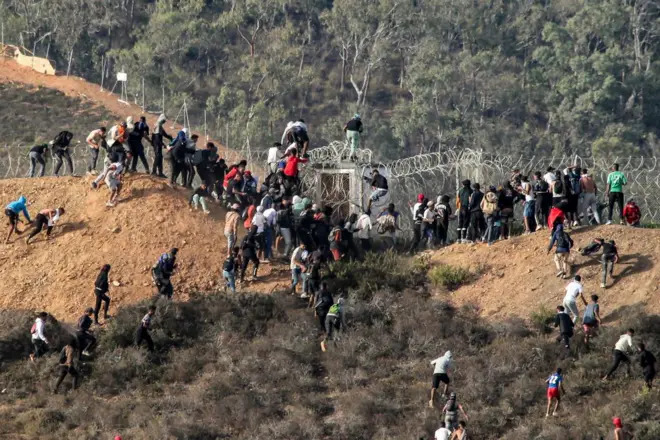
The latest wave of mass crossings into the Spanish enclave of Ceuta was far more than another episode of irregular migration. Rather, it exposed the convergence of three interconnected crises: Morocco's mounting socioeconomic pressures, the underlying tensions in Moroccan-Spanish relations, and the evolving European approach to migration. As tens of thousands of migrants reached Spain's North African border within days, the real question was not how they arrived, but why they chose this particular moment.
The stories told by young Moroccans who set out for Ceuta reveal a difficult reality: migration is no longer simply a dream of prosperity in Europe. For many, it has become an escape from shrinking economic opportunities and a growing sense of social stagnation. Rising youth unemployment, the widening mismatch between education and the labor market, and declining purchasing power have all contributed to making the risks of irregular migration appear less daunting than remaining trapped in an environment offering little hope for advancement.
This latest surge cannot be separated from the social protests that swept parts of Morocco last year, reflecting mounting economic pressures on broad segments of society, particularly young people. Official figures showing that roughly one in four Moroccans between the ages of 15 and 24 is neither employed, nor in education, nor receiving vocational training point to a structural crisis that extends well beyond temporary economic hardship and raises deeper questions about the country's ability to integrate its younger generations into productive economic life.
Yet social and economic grievances alone do not fully explain the sudden influx.
The immediate catalyst appears to have been the rapid circulation of reports on social media concerning a Spanish Supreme Court ruling on the treatment of migrants intercepted at sea while attempting to reach Ceuta or Melilla. Although the ruling did not grant migrants an automatic right to remain in Spain, fragmented or misleading interpretations created the widespread perception that crossing had become significantly less risky.
In this respect, the episode highlights the increasingly influential role of social media in shaping migration dynamics. Digital platforms are no longer merely spaces where migrants share success stories; they have evolved into active drivers of migration by creating perceptions—sometimes detached from legal reality—that can mobilize thousands of people within a matter of days. Managing information has therefore become almost as important as managing borders themselves.
Spain's response was swift and uncompromising. Although Prime Minister Pedro Sánchez's Socialist government has generally adopted a relatively open approach toward migration compared with many other European administrations, Madrid reacted firmly to the latest crossings. Sánchez described the incident as "a violation of Spanish sovereignty" and pledged to accelerate deportations while considering legislative amendments to tighten immigration procedures and strengthen border enforcement.
The government's reaction reflects a broader shift across Europe, where even traditionally liberal administrations have become increasingly sensitive to large-scale migration flows amid the growing influence of right-wing populist movements and the central role immigration now plays in domestic political debates and elections.
Perhaps the most complex dimension of the crisis, however, lies in Moroccan-Spanish relations.
Recent history has ensured that every major migration wave immediately raises questions about whether it reflects purely socioeconomic pressures or also carries an implicit political message. A similar surge occurred in May 2021, when Morocco was widely accused of relaxing border controls during a diplomatic dispute triggered by Spain's decision to admit the leader of the Polisario Front for medical treatment.
Although bilateral relations have improved considerably since then—particularly after Spain endorsed Morocco's autonomy proposal for Western Sahara—points of friction have not entirely disappeared. Sánchez's recent visit to Algeria and the Spanish Parliament's approval of legislation granting Spanish citizenship to descendants of Sahrawis have reopened politically sensitive issues in Rabat. Consequently, some analysts have questioned whether the latest migration wave also conveys a political signal, even if unofficially.
Such interpretations remain contested.
Moroccan authorities continue to deny using migration as an instrument of political leverage, while the Spanish government maintains that the crossings were primarily driven by misinformation surrounding the Supreme Court ruling rather than any deliberate change in Morocco's border policy.
Regardless of which explanation proves more convincing, the latest events once again expose the fragility of Europe's southern frontier. Ceuta and Melilla have long ceased to be merely Spanish enclaves in North Africa; they have become laboratories where development, migration, politics, and geography intersect in increasingly complex ways.
Many observers argue that treating migration solely as a security issue will not provide a lasting solution. Economic and social indicators in Morocco—as in much of the southern Mediterranean—suggest that the structural pressures driving migration are likely to persist. At the same time, modern communication technologies enable information, whether accurate or misleading, to spread rapidly and facilitate coordinated migration attempts on an unprecedented scale.
Europe therefore finds itself confronting a familiar dilemma. It depends heavily on Morocco's cooperation to manage its external borders, yet the sustainability of that cooperation remains closely tied to the broader political relationship between Rabat and Madrid, as well as Morocco's own capacity to address the socioeconomic conditions that compel thousands of young people to seek opportunities abroad.
Ultimately, the latest developments in Ceuta represent far more than a temporary border incident. They illustrate the convergence of Morocco's domestic socioeconomic challenges, evolving European migration policies, and the persistent geopolitical sensitivities shaping Moroccan-Spanish relations. Addressing this phenomenon will require far more than reinforced border controls. It demands a comprehensive strategy that integrates economic development, effective migration management, and stable bilateral cooperation. After all, no matter how high the fences become, borders alone cannot stop migration when the loss of hope becomes the strongest force driving people to cross them.
Most read