War Narrows Trump's Room for Maneuver

Five months after the outbreak of the war with Iran, U.S. President Donald Trump finds himself facing increasingly complex choices as military confrontations continue to expand across the Middle East. With no political settlement or diplomatic exit in sight, the conflict has evolved into a prolonged regional crisis, despite a diplomatic breakthrough claimed by his administration through the announcement of an agreement on the disarmament of Hamas in the Gaza Strip.
Trump is coming under mounting pressure as his strategy of forcing Iran to retreat through military pressure has failed to produce the desired results. Speaking on Wednesday following U.S. strikes against Iranian targets in retaliation for attacks on American bases in Jordan, the president declared, "We will strike them hard because our time has come," reaffirming his commitment to the military option despite its limited effectiveness thus far.
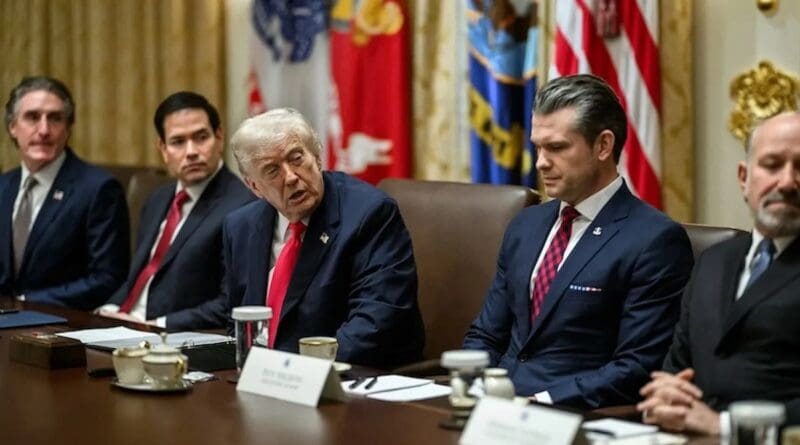
As hostilities have spread to Iraq, Saudi Arabia, and Egypt, the U.S. administration now faces an increasingly complex regional crisis. A meeting Trump held with members of his Cabinet at Camp David on Friday offered no indication that Washington was preparing to alter its current strategy.
According to NBC News, citing unnamed U.S. officials, Trump expressed deep frustration during a White House meeting over the limited options available to bring the war to an end, acknowledging that the prospects for a negotiated settlement now depend largely on decisions made in Tehran.
The conflict began on February 28, when the United States and Israel launched coordinated strikes against Iran. According to the account cited in the report, the attacks killed Iran's Supreme Leader, Ayatollah Ali Khamenei, along with several senior officials. At the time, Trump reportedly expected the military campaign—launched with the objective of preventing Iran from acquiring nuclear weapons—to conclude within four to six weeks.
Although U.S. officials maintain that the campaign achieved important military objectives, including inflicting severe damage on Iran's navy and significantly degrading its ballistic missile capabilities, the war has since entered a new phase centered on control of the Strait of Hormuz. This development has disrupted global trade and presented Washington with additional strategic and economic challenges.
A framework agreement reached between Washington and Tehran on June 17 subsequently collapsed after facing criticism within the United States. Fighting resumed on July 7, with renewed American strikes against Iranian military installations followed by retaliatory attacks from Iran's Islamic Revolutionary Guard Corps targeting U.S. bases and Washington's regional allies.
Richard Haass, former president of the Council on Foreign Relations, questioned whether the current strategy could succeed after months of continuous fighting, arguing that it has failed to deliver the intended results.
Karen Young, a senior fellow at the Middle East Institute in Washington, likewise warned that the conflict remains in its early stages. She argued that prolonged instability could have lasting consequences for global energy markets and regional security, adding that any political transition within Iran could generate further instability rather than ease tensions.
The war has also cast a shadow over the Gulf region, where Saudi Arabia and neighboring countries have been subjected to repeated attacks. These developments have unsettled oil markets, pushed global fuel prices higher, and reduced the purchasing power of American consumers.
Public support for the war has meanwhile continued to erode. Polling data published by political analyst Nate Silver indicate that 58.3 percent of Americans oppose the conflict, while only 37.4 percent support it—a gap that has widened steadily since March.
The issue has become increasingly sensitive politically as the November midterm elections approach. Should the war continue without producing clear strategic gains, the Republican Party risks losing its congressional majority.
Analysts conclude that the prolonged confrontation has placed both Washington and Tehran in a costly war of attrition, draining the resources of both sides without delivering a decisive strategic advantage to either. At the same time, concerns continue to grow over the possibility of further regional escalation and its broader implications for international security and the global economy.
Adapted from a report originally published by Hespress.
Most read