Saddam Haftar and the Reconfiguration of Libya's Balance of Power: A Preliminary Assessment

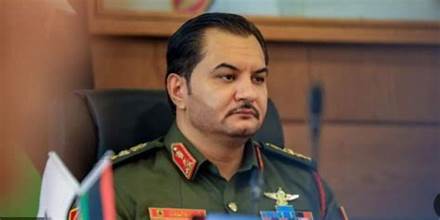
The rise of Lieutenant General Saddam Khalifa Haftar within the General Command of the Libyan National Army (LNA) should not be viewed merely as an organizational development within the military establishment in eastern Libya, nor simply as a natural extension of the position held by his father, Field Marshal Khalifa Haftar. Rather, the timing of his ascent, the expanding scope of his responsibilities, and the growing diplomatic and military engagement associated with his name all suggest that this development should be understood within the broader context of Libya's evolving political landscape and its regional and international dynamics.
Libya continues to experience profound institutional fragmentation, with competing executive, legislative, and security authorities operating in parallel. Successive political initiatives have failed to produce a unified government or pave the way for nationwide elections capable of bringing the prolonged transitional period to an end. Against this backdrop, the military institution in eastern Libya has emerged as one of the country's most cohesive and organized state structures, making it an increasingly significant actor in any discussion concerning the future of Libya's political order.
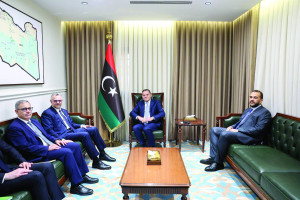
Within this context, Saddam Haftar's rise appears to be part of a broader redistribution of responsibilities within the General Command. At the same time, it reflects an effort to project a new generation of military leadership capable of managing responsibilities that extend beyond conventional defense matters to encompass foreign relations, border security, defense cooperation, and engagement with local actors across Libya's diverse regions. His activities over the past period demonstrate a clear emphasis on expanding military and diplomatic networks, a development that has further strengthened his profile within the Libyan political landscape.
Nevertheless, interpreting this growing prominence as evidence of a predetermined leadership transition or an international consensus behind a particular individual would be premature. International approaches to the Libyan crisis remain primarily driven by broader strategic priorities, including preserving stability, preventing a return to large-scale armed conflict, safeguarding the uninterrupted flow of oil exports, and containing the challenges posed by irregular migration and terrorism, rather than by support for any specific political figure or faction. Consequently, the growing engagement of certain regional and international capitals with influential figures in eastern Libya is better understood as part of a broader strategy of maintaining communication with all major centers of influence, rather than as a definitive political endorsement.
Domestically, perceptions of Saddam Haftar's emergence remain deeply divided. In eastern and southern Libya, many view the military establishment as one of the principal guarantors of security and stability, considering the renewal of its leadership as a factor that could reinforce its institutional role. In contrast, political and military actors in western Libya continue to view any expansion of the General Command's influence with caution, fearing that it could reinforce existing divisions or upset the delicate balance underpinning the political process.
This divergence illustrates that the debate extends well beyond Saddam Haftar himself. At its core lies a broader question concerning the role that the military institution should play in Libya's next political phase. The Libyan crisis is no longer simply a dispute between competing governments or rival authorities; it has evolved into a challenge of state-building—one that requires redefining the relationship between civilian and military institutions while establishing a constitutional framework capable of securing broad national legitimacy.
Likewise, the General Command's recent external engagements reflect a wider trend toward diversifying defense and military partnerships. This development is not unique to Libya but has become increasingly common among several countries in the region seeking greater strategic flexibility by cultivating relations with multiple international powers in an evolving global environment characterized by a diffusion of influence and the gradual erosion of traditional patterns of geopolitical polarization.
At the same time, developments within the military sphere cannot be separated from Libya's wider political and economic environment. Persistent disputes over the distribution of oil revenues, the management of sovereign institutions, and the framework governing future elections ensure that any shift in the military balance of power will inevitably influence the political process. Yet military developments alone cannot produce a durable settlement unless accompanied by broader national consensus and institutional compromise.
Accordingly, the significance of Saddam Haftar's rise lies not merely in his emergence as a representative of a new generation within the General Command, but also in what it reveals about the evolving nature of the Libyan crisis itself. Military and security institutions have increasingly become integral components of any future political settlement, alongside political and economic institutions, reflecting the limitations that purely political initiatives have demonstrated over the past decade.
Ultimately, Libya appears to be entering a phase marked less by the rapid resolution of its conflict than by the gradual reconfiguration of its centers of power. Within this evolving landscape, Saddam Haftar's emergence represents one manifestation of that transformation rather than its sole driving force. The long-term significance of his role will depend on the ability of Libya's competing actors to forge an inclusive political framework, as well as on the success of regional and international efforts to support a settlement that preserves the unity of the Libyan state and its institutions while avoiding the logic of domination or exclusion.
Most read