
Why Is the Alliance Partnering with Comprehensive Cybersecurity Giants?

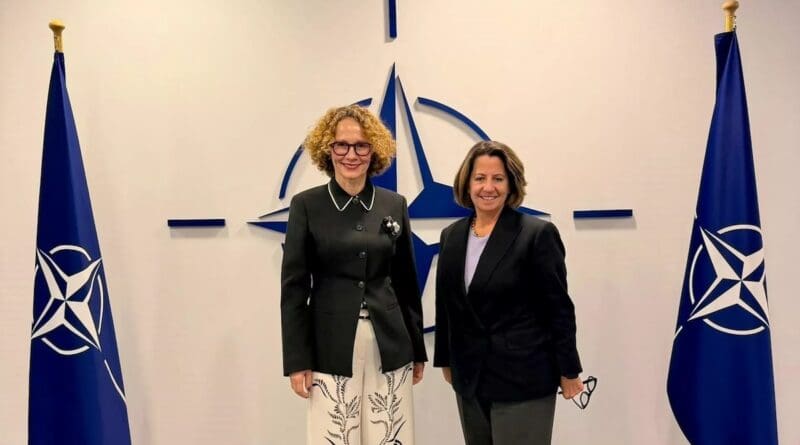
In a move that reflects profound transformations in the nature of international security, NATO has announced new strategic partnerships with major technology companies, including Microsoft, Palo Alto Networks, and ESET, aimed at strengthening resilience against cyber threats and protecting the global digital sphere. Although the announcement appears technical on the surface, its real implications extend far beyond cybersecurity into the broader redefinition of power, alliances, and sovereignty in the modern international system.
The world is no longer operating solely within the framework of conventional military competition. Instead, it has entered an era in which cyber warfare intersects with national security, economic stability, critical infrastructure, energy systems, and even political processes. In this context, NATO increasingly recognizes that protecting member states is no longer limited to tanks, missiles, and military bases; it now depends heavily on securing digital networks, data systems, and the electronic infrastructure upon which modern societies rely.
From Military Deterrence to Digital Deterrence
Since its establishment in 1949, NATO has been built around the concept of collective defense against conventional military threats, particularly during the Cold War. However, the digital revolution of recent decades has forced the alliance to reconsider the nature of the threats confronting it.
Cyber threats today are no longer confined to isolated hacking incidents or limited technical breaches. They have evolved into strategic tools capable of disrupting power grids, targeting financial systems, manipulating information, influencing elections, and crippling critical infrastructure.
The Russia–Ukraine war clearly demonstrated the extent to which international conflict has transformed. Cyberattacks became a parallel battlefield accompanying conventional military operations, while state-linked hacker groups and non-state cyber actors proved capable of launching transnational attacks with consequences comparable to traditional military strikes.
Against this backdrop, NATO’s partnership with major technology companies should not be viewed merely as a technical arrangement, but rather as an attempt to establish a form of “collective digital deterrence” parallel to the alliance’s traditional military deterrence structure.
Why Does NATO Need Technology Companies?
The latest move highlights a significant shift in the balance of power within the international system. States no longer possess exclusive control over cyberspace. Large technology companies now command enormous capabilities that, in some areas, surpass those of entire governments — whether through control of digital infrastructure, ownership of data, or leadership in artificial intelligence and cybersecurity technologies.
NATO understands that confronting modern cyber threats cannot rely solely on armies or traditional intelligence agencies, because much of the global digital infrastructure is fundamentally operated by the private sector.
Western governments increasingly depend on cloud computing services, AI technologies, and digital security systems developed by major technology firms. These companies are often capable of detecting attacks, analyzing threats, and deploying defensive responses faster than conventional state bureaucracies.
As a result, the new partnerships reflect a growing recognition that cybersecurity is no longer exclusively a state responsibility, but rather a shared domain requiring close cooperation between governments and private industry.
Cyber Warfare and Great Power Competition
This initiative comes at a time of intensifying digital competition among major powers, particularly the United States, China, and Russia. Cyberspace has become an open arena where security, economic, technological, and intelligence interests intersect.
Western governments have repeatedly accused Russia of using cyber operations to destabilize rivals and target sensitive infrastructure, while concerns continue to grow over China’s expanding technological capabilities in areas such as artificial intelligence, telecommunications networks, and big data.
Meanwhile, both Moscow and Beijing argue that the West uses the rhetoric of “cybersecurity” to justify expanding its digital influence globally and imposing Western technological and political standards on cyberspace governance.
In this sense, NATO’s alliance with technology firms cannot be separated from the broader global struggle over who controls digital infrastructure and who defines the rules governing cyberspace security and digital governance.
Digital Infrastructure: The Most Vulnerable Target
One of the most dangerous aspects of this transformation is that modern societies have become deeply dependent on digital systems. Electricity grids, water supplies, airports, banks, hospitals, transportation networks, and even military systems are now interconnected through cyber infrastructure.
This means that a large-scale cyberattack could evolve into an existential threat to a state without a single shot being fired.
Recent years have witnessed a sharp increase in attacks targeting critical infrastructure, whether through ransomware, state-sponsored intrusions, or operations directed at energy and communications networks.
NATO’s concerns therefore reflect a growing realization that future wars may not necessarily begin with missiles or military invasions, but rather with digital attacks capable of paralyzing entire countries within hours.
Toward a “Digital NATO”?
What is particularly striking about NATO’s recent moves is that the alliance is not merely seeking to defend its members against cyberattacks. It is gradually working to build a transnational cyber cooperation system linking governments, private companies, technical experts, and cybersecurity institutions.
This opens the door to what could be described as a “Digital NATO” — a global security framework based on information sharing, coordinated response mechanisms, and collective cyber defense capabilities.
However, this direction also raises complex questions regarding privacy, digital sovereignty, and the growing role of private corporations in managing national security affairs.
The deeper the partnership between governments and technology companies becomes, the more concerns emerge regarding the extent of influence these corporations may wield over political and security decisions, and whether they could evolve into independent geopolitical actors with influence rivaling that of states themselves.
Conclusion
The new alliance between NATO and major technology firms demonstrates that the world has entered a fundamentally new phase of international competition — one in which power is no longer measured solely by military strength or conventional arsenals, but also by the ability to secure cyberspace, control data, and protect digital infrastructure.
In this new environment, cybersecurity has become an essential pillar of national security, while technology companies have emerged as key actors within global power dynamics alongside states, armies, and traditional alliances.
As NATO attempts to construct a form of “digital deterrence umbrella” for its members, current developments suggest that future wars may be decided as much by algorithms, networks, and cyber capabilities as by missiles, aircraft, and conventional military force.
Most read