U.S. Tariffs After the Supreme Court Ruling: A Temporary Escalation or a Reset of Global Trade Policy?

The ruling by the Supreme Court of the United States, which declared the sweeping tariffs imposed by U.S. President Donald Trump unlawful, has once again injected uncertainty into global trade—particularly after the president announced on Saturday a new 15 percent tariff.
Just weeks after his inauguration in January 2025, Trump had imposed tariffs on both allies and adversaries under the International Emergency Economic Powers Act (IEEPA), triggering a trade war that shook global commerce.
However, in a 6–3 decision issued on Friday, the Supreme Court ruled that Trump had exceeded his authority by invoking the 1977 law, which was originally designed to allow U.S. presidents to respond to specific national emergencies. The court stated that tariffs constitute a form of taxation and that, under Article I of the U.S. Constitution, the power to levy taxes rests exclusively with Congress.
The ruling does not apply, however, to Trump’s tariffs on steel, aluminum, lumber, and automobiles, which were imposed under a different statute—Section 232 of the Trade Expansion Act of 1962.
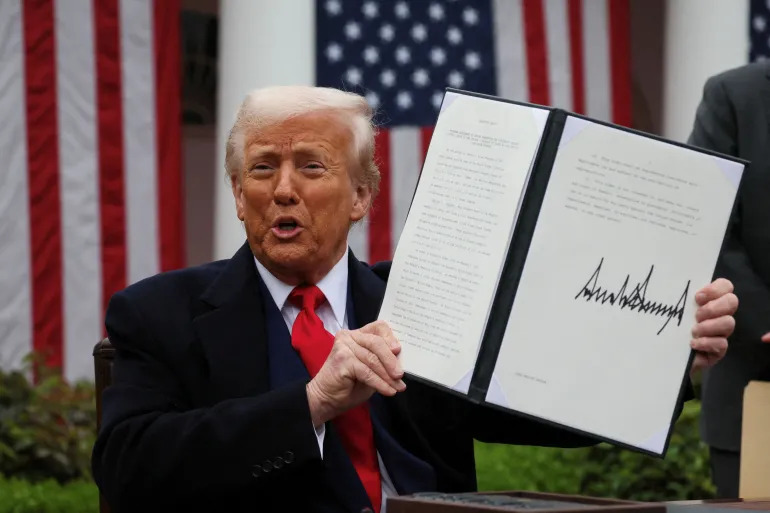
Following the decision, an angry Trump lashed out at Supreme Court justices, calling them “fools and lapdogs” who were “very unpatriotic and disloyal to our Constitution.” He immediately signed an executive order under Section 122 of the U.S. Trade Act of 1974 imposing a blanket 10 percent tariff on all countries trading with the United States beginning February 24, before raising it on Saturday to 15 percent—the maximum allowed under the law.
This development has raised questions about the new legal framework Trump is using and its implications for trade agreements the United States has already concluded worldwide.
What Is the New Trade Law?
Under Section 122 of the U.S. Trade Act of 1974, the president is authorized to impose tariffs of up to 15 percent to address “large and serious balance-of-payments deficits.” These tariffs may remain in effect for only 150 days unless Congress approves an extension. Trump is the first U.S. president to invoke this provision to impose tariffs.
The White House stated that certain goods would be exempt from the temporary levy, including specific agricultural products such as beef and tomatoes, natural resources and fertilizers that cannot be produced domestically, as well as aerospace products and others.
After the court ruling, William Bain, head of trade policy at the British Chamber of Commerce, said the decision “does little to clear the murky waters for business.” The UK government indicated it was working with Washington to better understand the ruling’s impact on Britain, noting that existing deals covering steel, aluminum, and pharmaceutical exports would not be affected.
Bain warned, however, that the new 15 percent global tariff rate “will be bad for trade, bad for U.S. consumers and businesses, and will weaken global economic growth.”
China
China was among the countries most heavily targeted by U.S. tariffs, pushing the world’s two largest economies into a trade war in which reciprocal tariffs exceeded 100 percent on some goods. Although no comprehensive trade agreement has been signed, both sides agreed to ease tariffs as part of a truce following several negotiation rounds and a summit between Trump and Chinese President Xi Jinping in South Korea in October. The baseline tariff was reduced to 10 percent, and Trump also cut the so-called “fentanyl tariff” to 10 percent.
India
India faced some of the highest U.S. tariff rates, reaching 50 percent after an initial 25 percent levy was followed by another 25 percent linked to India’s purchases of Russian oil. Earlier this month, the two countries reached a framework trade deal under which Trump said Prime Minister Narendra Modi agreed to halt Russian oil imports in exchange for lowering U.S. tariffs on India’s major exports to 18 percent. India, in turn, pledged to reduce or eliminate tariffs on U.S. industrial goods and several agricultural products. An Indian trade delegation scheduled to finalize the agreement in Washington has since been postponed.
European Union
The United States and the European Union reached a deal last July to avert a transatlantic trade war after Trump imposed 30 percent tariffs on imports from the bloc, with EU exports set to face a 15 percent rate. The agreement has not yet taken effect, however, after EU lawmakers paused ratification following Trump’s threat to annex Greenland. The European Parliament’s trade committee is due to vote on the deal on February 24, but the court ruling and new tariffs have cast uncertainty over its future.
Mexico
Mexico was among the first countries targeted by Trump’s tariffs, facing a 25 percent levy on certain pharmaceuticals and an additional 25 percent “fentanyl tariff.” About 85 percent of Mexican exports to the United States were exempt under the U.S.–Mexico–Canada Agreement (USMCA). The Supreme Court ruling is expected to ease tariff pressure on Mexican exports, but the agreement’s upcoming review later this year has raised concerns that new levies could be imposed if it lapses. Mexico’s economy minister, Marcelo Ebrard, has said he will travel to Washington soon to discuss the issue.
What Happens Next?
Countries are now watching closely to see how the court ruling and the new tariffs will unfold in practice. Trade experts believe the U.S. administration will use the 150-day window during which the Section 122 tariffs remain in force to launch investigations under Section 301 of the Trade Act, aimed at identifying unfair trade practices and reinstating reciprocal tariffs that were struck down by the court.
Most read