“The Intimacy of Things”: Poetry in the Crosshairs of Memory and Forgetting

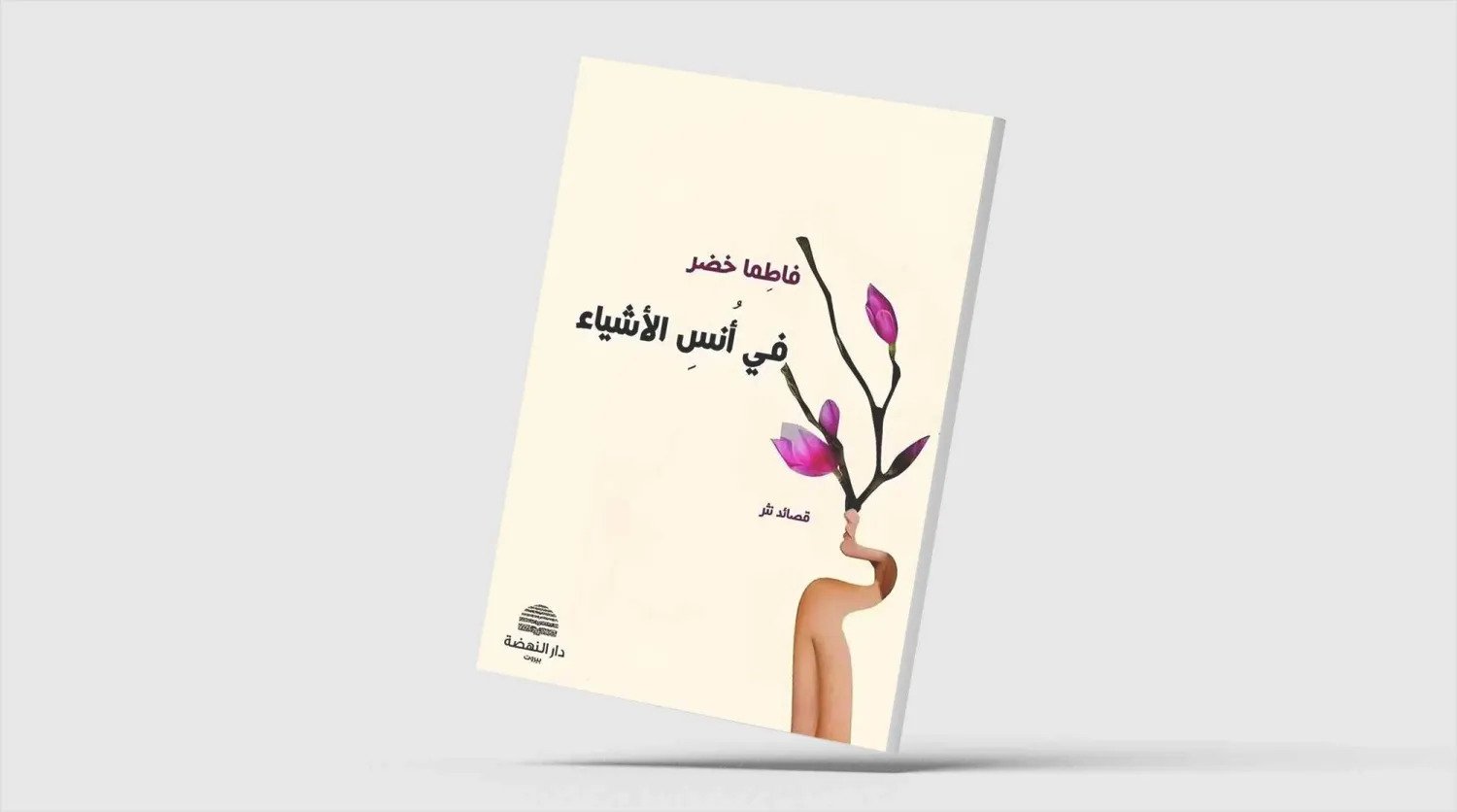
Fatima Khadr Searches for an Imagined Life Beyond Fear and War
An intense love of poetry, and a passion for it as an alternative, imagined life—one that is more just and secure amid a world endlessly consumed by absurdity and war—permeate The Intimacy of Things, a poetry collection by Syrian poet Fatima Khadr.
This passion manifests itself in the poet’s persistent excavation of poetry’s depths and her exploration of its labyrinthine corridors. She engages with poetry as though it were a beloved lover, alternately quarrelling with it and making peace with it, searching its secret pockets for the meaning of existence and the truth of life. She experiences it as a twin to the soul and music, dedicating her collection to the mountains of her hometown, Tartus, and its magnificent coastline. Poetry, after all, is the arc that spans beginning and end; in their shadows, she renews her capacity to give and to dream. She therefore addresses poetry as a saviour. In a poem bearing that very title, “The Saviour,” she writes:
I write poetry
because I am born
I write poetry
because I die
The poet does not stop at this powerful cry, steeped in the impulses of birth and death. Instead, she opens the same poem onto a broader horizon of meaning, intensifying its significance and emotional resonance, as well as the ideas that lie beneath the surface. Nothing but poetry, it seems, can gather up a shattered life, restore it to its human nature and original instinct, and recover a measure of lost equilibrium—a balance that has become an open wound, exposed to deeper wounds whose echoes reverberate throughout the realities of existence.
O Poetry, wrap me
in a cloud embracing the moon
to conceal its sorrow...O Poetry, draw me
as a blade of grass rising...
returned by the Absolute
to the earthO Poetry, call me by my name
so that words may blossom
in the forests of my tongueGather me
from among the references of nothingness
Scatter me
among the interpretations of existence
This oscillation between existence and nothingness casts its shadows over the architecture of the collection, recently published by Dar Al-Nahda in Beirut. Spanning 90 pages, the book is organized into six principal sections, each containing five poems. This structure presents us with poetic quintets that intersect and resonate with one another from one text to the next, varying in length according to the emotional state of the poetic self.
There is, then, an awareness of poetry, but it is a troubled awareness, reassured by nothing and perpetually besieged by fear, absurdity, and monotony—the weariness of a life that repeats itself day after day under the weight of inherited legacies and traditions.
Within this bleak atmosphere, how does a poem acquire its many lives? Through experimentation, adventure, and breaking with the monotony of the familiar and commonplace? Or does it remain suspended in the grip of doubt and fear, awaiting a miracle whose fragments have scattered between earth and sky, past and present?
Perhaps the solution lies in outmanoeuvring life itself, playing with the shifting boundaries between clarity and ambiguity, between black and white, both within and beyond the self. Yet this is an illusory manoeuvre, one that lacks the will to hold fast to life. Poetry becomes a mask for life or, at best, a mournful elegy for its sudden departure.
This tension emerges in a poem titled “The Lives of the Poem” (p. 13), in which the poet writes:
The moment it is born
the poem dies
after having lived an idea
through its first lifeIts spirit returns
to experience a second birthSometimes it assumes
a life of forgetting
neglected on a library shelf
waiting for its pulse
to be restoredSome poems are granted
a banal existence
girls’ love-talk that melts away quickly
leaving behind a sticky traceSometimes
it lives as music’s twin
rests its head on lovers’ notebooks
keeps company with sleepless nights
accompanies those who travel the roads
Along similar lines, in an attempt to grasp the psychology of poetry and its sudden manifestations, she writes in a poem titled “Disorientation” (p. 17):
The fears of the poem
unsettle meI surround it with an amulet
to protect it
I wrap us both
in all the feeling I can musterThen I leave it
to take shape
as a gazelle of meaning
The idea of the mask emerges here through a play on opposites: “assuming a life of forgetting.” Poetry appears as a state of disorientation, an unseen struggle between an idea and its birth. The poem, in turn, seems to require an “amulet” to protect it from the forces of dissolution.
This reading is reinforced by the way symbols and their semantic fields function throughout the collection. They are not merely vehicles for conveying something else; rather, they are signs that almost stand on their own, trembling with the fear that hope might remain suspended on the wall of oblivion, without a memory or trace to attest to its existence.
The poetic self therefore turns toward the past, seeking to summon history and inhabit it anew: the ancient history of Syria, its heritage-rich cities, and its enduring myths. These memories intersect with the present reality and the deterioration of conditions across the country.
In a poem titled “Uprooting” (p. 31), she writes:
In a former life
when things assumed
their original formsrocks were filled with pulses
springs sang
the air carried dreamsthe Phoenician Sea
was beyond the reach of ruin
ships carried the first glassseeds of the Ugaritic alphabet
ripened
the theatre of Amrit
was the womb of civilizationlooms wove joy
women coloured the horizon
their braids dancing
with the wind
The poem relies on a descriptive structure that evokes what once existed and, from its depths, anticipates what might yet come to be. This is why courtship and the humanization of things emerge as two central pillars of the collection.
The poems also loosen the grip of causal relationships that confine poetic imagery between the poles of cause and effect, as in phrases such as “to conceal its sorrow” and “so that words may blossom in the forests of my tongue.”
Instead, the poetic self relies on its own resources, courting poetry with spontaneity and affection. It opens every window and door to it, embraces it in body and soul, and begs it not to arrive late, lest it become angry. Poetry, in turn, reciprocates these feelings, asking the poet to ease her anxiety and the oppressive weight of time, and to adorn herself fully when she begins to write.
This dynamic becomes particularly evident in “Silent Companionship” (p. 57), where the poet writes:
I live in the company of things
free from attachment and argumentMy presence is light
before the weight of wordsSolitude has indulged me
I have blossomed into gentlenessFrom my bag
the key is almost leaping
my footsteps hasten the roadThe house and all its things
await an embrace
reassured by my arrivalThe place grows green
the threshold widens
water flows like a breeze
across my bodyThe towel breathes through my pores
my clothes fall away, adrift
I grow more tenderThe refrigerator calls to me
spoons and dishes sing
familiarity embraces my wearinessMy diary longs
for the pen to touch its ground
carrying all my detailsI sit at my desk
the books’ gazes blossom on the shelves
scattered quotations smileThe breath of folded pages
the keyboard lights up
my fingerprints leave their trace
in their spiritI listen to silence
I taste delight
in the intimacy of things
Ultimately, the collection confronts us with what might be called a “poetics of pattern” or a “poetics of the frame.” Yet one of its most striking artistic features remains its focus on the details of everyday life, portraying them as friendly beings and signs that awaken memory and open it to the associations of places and people.
This quality is particularly evident in the section titled “Exercises in Love,” where the tree, the café, the shadow, and the metaphor emerge as striking signs that love has passed through here.
Originally published in the Saudi newspaper Asharq Al-Awsat.
Most read