
In the East, dabke dances are not born in luxurious theaters or exclusive art academies; they emerge from the land itself—from harvest seasons, weddings, and dusty village squares where people gather around collective joy, as though dance were an ancient way for human beings to declare that they are still alive despite everything.
For this reason, traditional dabke among Arabs and Kurds is not merely a folkloric performance, but rather a part of collective memory and a reflection of the relationship between individuals, their communities, and their surroundings.
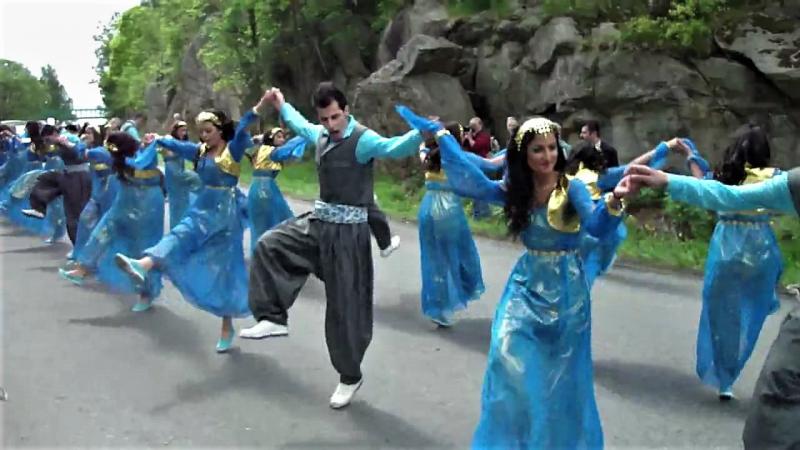
Anyone who closely observes Kurdish dabke will quickly realize that it is not far removed from the spirit familiar to Arabs in their own traditional dances across the Levant, Iraq, and large parts of the region.
The same collective rhythm, the same interlocked hands, the same idea of the circle that is incomplete without everyone participating—and even that internal feeling which transforms communal dancing into an unwritten declaration of solidarity and belonging.
These details were among the cultural dimensions highlighted by the “Takamul… Arabs and Kurds… A Shared Destiny” campaign, affiliated with the International Istishraf Network for Studies and Media. Through cultural materials, videos, and publications, the campaign sought to emphasize the depth of human closeness between the two peoples through art and folk heritage. After all, people often discover their true proximity to one another in moments of joy rather than in long political debates.
In Kurdish weddings, just as in many Arab celebrations, dabke becomes a communal space where social, political, and even generational differences temporarily disappear. Everyone participates, everyone moves to the same rhythm, as though the deeper message carried by these popular rituals is that the community is stronger when it moves together.
Perhaps this is what gives folk dances their profound symbolic value in the cultures of the region. They are not merely organized movements, but an expression of the idea of “shoulder to shoulder,” of the importance of community, and of the ancient bond between people, their land, and their society.
In the Kurdish experience in particular, folk dances have preserved a strong presence despite the enormous political and social transformations the region has undergone over recent decades. Indeed, these arts may have become even more important as tools for preserving identity and collective memory.
At the same time, Arab societies also maintain a deeply rooted connection with dabke and traditional dances, especially in the Levant and Iraq, where these forms of expression remain central to social and national occasions.
It is encouraging today to witness such folk arts gradually transforming into spaces for cultural rapprochement between Arabs and Kurds—whether through festivals, joint events, or even short videos circulating widely on social media and receiving significant engagement from both sides.
When a person sees another celebrating in almost the same way, they instinctively feel that the distance between them is not as great as they once imagined. This is precisely what the “Takamul” campaign sought to build upon: reintroducing Arab–Kurdish relations through simple, everyday commonalities that people naturally understand, without heavy ideological rhetoric or rigid slogans. For the problem in our region has never been the absence of shared experiences, but rather the absence of attention directed toward them.
For many years, the peoples of the region lived under the influence of political and media discourses focused on differences and closed identities, while the broad spaces that unite ordinary people in their daily lives were largely ignored.
Thus, reviving folk arts and shared heritage is not merely a cultural matter; it is an attempt to reconstruct a calmer and more humane image of the relationship between societies. Folk art also possesses a crucial advantage: it reaches people quickly because it resembles them and emerges from their real environment, not from cold official rhetoric.
Perhaps this is why the image of Arab and Kurdish youth dancing the same dabke together at a simple gathering can sometimes be more influential than dozens of political statements—because the body never lies when it rejoices.
And in a region that has spent years searching for a new language of understanding, dabke, in all its simplicity and spontaneity, may be one of the most sincere languages of all.
Originally published on Al Nahar News
Most read