
The current conflict in Sudan cannot be adequately understood as merely a power struggle between the Sudanese Armed Forces (SAF) and the Rapid Support Forces (RSF), nor simply as a continuation of the political turmoil that followed the fall of President Omar al-Bashir in 2019. Rather, it should be viewed as the culmination of a much longer historical process in which the Sudanese state was constructed upon colonial foundations rather than an inclusive national project. In this sense, the war that erupted in April 2023 exposed not only a contest over political authority but also a profound structural crisis concerning the nature of the Sudanese state, the formation of its national identity, and the mechanisms through which political power and economic resources have historically been distributed among its diverse regions and communities.
A historical examination of Sudan's state formation reveals that the country did not emerge as a conventional nation-state shaped through the gradual political evolution of a cohesive society. Instead, it was largely the product of a colonial administrative project designed to serve Anglo-Egyptian strategic interests rather than to foster a unified national identity. The very term Sudan originally referred to a vast geographical and civilizational zone extending across Sub-Saharan Africa before being transformed, at the end of the nineteenth century, into the official designation of a territorially defined political entity under the Anglo-Egyptian Condominium established after the reconquest of 1898. Consequently, the territorial boundaries upon which modern Sudan was built reflected imperial administrative logic far more than indigenous political or social realities.
This distinction is of fundamental importance because colonial rule succeeded in creating administrative unity without achieving social or political integration. Upon independence, Sudan inherited a territorially consolidated state but not a consolidated nation. The colonial administration neither resolved nor meaningfully addressed the country's profound ethnic, cultural, religious, and regional diversity. As a result, the post-independence state lacked an inclusive national identity capable of transcending local and regional loyalties. Many of the tensions that continue to characterize Sudanese politics—including those between the political center and the country's peripheral regions—are therefore better understood as manifestations of an incomplete nation-building process rather than merely contemporary political disputes.
The colonial legacy extended well beyond territorial demarcation to shape the very architecture of political authority. British administrators governed Sudan largely through a system of indirect rule that empowered selected local elites—predominantly in northern Sudan—while marginalizing large segments of the population in the south, Darfur, and other peripheral regions. This governance model created a politically privileged elite whose interests became closely tied to maintaining centralized authority. Following independence, power was transferred largely to these same social and political groups without fundamentally transforming the structures through which the state exercised authority or distributed economic resources. Consequently, the post-colonial state inherited not only colonial institutions but also many of the inequalities embedded within them.
This trajectory closely reflects the analysis advanced by Frantz Fanon, who argued that the national bourgeoisie emerging in former colonies frequently reproduces the institutions and governing practices of colonial rule rather than dismantling them. Lacking an independent economic base, these elites often seek to preserve the political and administrative privileges inherited from the colonial state instead of undertaking comprehensive structural reform. Sudan offers a compelling illustration of this dynamic. Independence represented less a transformation of state institutions than a transfer of control from colonial administrators to domestic elites, while the centralized model of governance—and its unequal patterns of political and economic inclusion—remained largely intact.
Against this backdrop, Sudan's repeated cycles of military intervention appear less as historical anomalies than as structural consequences of a fragile political order. Beginning with General Ibrahim Abboud's coup in 1958, followed by Jaafar Nimeiri's seizure of power in 1969 and Omar al-Bashir's coup in 1989, military intervention became the principal mechanism through which political authority was transferred. These recurring coups reflected the inability of Sudan's civilian institutions to establish stable mechanisms for constitutional governance and peaceful political competition. Over time, the military evolved beyond its conventional defense role to become the dominant political institution within the state, further weakening civilian governance and reinforcing the logic of authoritarian rule.
Successive governments also deepened the imbalance between the political center and Sudan's peripheral regions through unequal patterns of development and resource allocation. Persistent political and economic marginalization fueled successive insurgencies, first in southern Sudan and later in Darfur, South Kordofan, and Blue Nile. These conflicts should not be interpreted solely through an ethnic lens. Rather, they reflected deeper structural disputes concerning state formation, political representation, and the distribution of national resources.
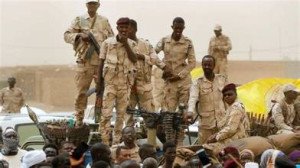
Within this context, successive governments increasingly relied upon locally recruited militias to perform security functions that exceeded the capacity—or political willingness—of the regular armed forces. Over time, these militias evolved from auxiliary security instruments into autonomous centers of military and economic power. The most consequential example was the Janjaweed, which was later institutionalized as the Rapid Support Forces (RSF), eventually becoming one of Sudan's most influential military actors.
Viewed from this perspective, the current war represents not simply a confrontation between two competing military organizations but the logical outcome of Sudan's long-standing state-building crisis. The conflict between the Sudanese Armed Forces and the Rapid Support Forces reflects the emergence of rival coercive institutions operating within the same state, a consequence of decades of fragmented security governance, weakened civilian institutions, and the absence of a comprehensive national project capable of redefining the relationship between the state and society.
Moreover, the implications of Sudan's crisis extend well beyond its national borders. The Horn of Africa has long been characterized by what many scholars describe as a regional conflict system, in which domestic conflicts are deeply intertwined with the strategic interests of neighboring states and external powers. Consequently, the continuation of Sudan's civil war threatens not only the country's territorial integrity but also the broader stability of the Horn of Africa and the Sahel. Expanding refugee flows, cross-border armed movements, humanitarian emergencies, and intensified regional competition have transformed Sudan's internal conflict into a central component of a wider regional security crisis, underscoring the extent to which Sudan's future has become inseparable from the geopolitical dynamics of its surrounding region.
Most read



Read also