

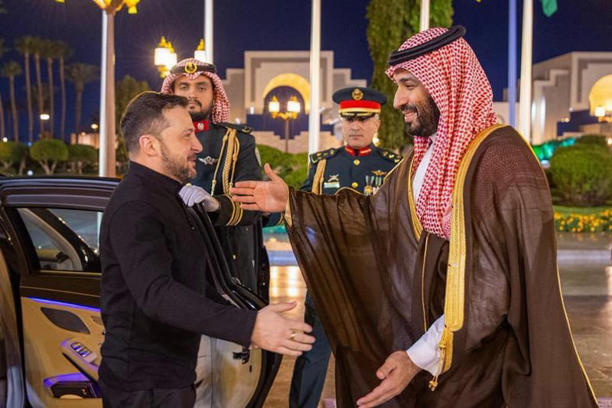
Amid the rapid transformations reshaping the international system, the defense agreements signed by Ukraine with Saudi Arabia, the United Arab Emirates, and Qatar appear to be far more than mere technical military cooperation. They reveal the emergence of a new pattern of transregional security partnerships, in which the experience of modern warfare is transferred from European battlefields to zones of tension in the Middle East. This dynamic reflects a geopolitical equation that extends beyond the boundaries of the Russia–Ukraine war itself.
Exporting the Experience of War
Since the outbreak of the war between Russia and Ukraine in 2022, Ukrainian territory has effectively become a testing ground for modern technological warfare, particularly in the field of drones. Russian attacks using Iranian-made Shahed drones pushed Kyiv to develop innovative defensive systems based on relatively low-cost methods that are nonetheless effective in intercepting unmanned aerial vehicles.
Today, Ukraine is attempting to transform this battlefield experience into a tool of diplomatic and economic influence. Countries facing similar drone threats—particularly in the Middle East—represent a natural market for these new defense technologies. In this sense, Ukraine is gradually shifting from a state that primarily receives military assistance to one that exports security expertise gained through war—an evolution with significant implications for its position in the international system.
The Gulf’s Search for a New Deterrence Equation
Meanwhile, Gulf states face a growing security challenge stemming from the proliferation of low-cost drones, whether in the context of tensions with Iran or through armed groups allied with it across the region.
Recent developments in the Middle East have demonstrated that traditional air defense systems, despite their sophistication, are not always the most efficient response to this type of threat. Launching an interceptor missile that may cost millions of dollars to destroy a relatively cheap drone creates a clear economic imbalance in the deterrence equation.
This is precisely why the Ukrainian experience has become attractive to Gulf states. It offers a different model of air defense—one based on lower-cost interception systems that are more flexible in dealing with large numbers or swarms of drones.
Where Two Geopolitical Arenas Converge
Beyond the technical dimension, these agreements highlight an intersection between two distinct geopolitical arenas: the war in Europe and the security conflicts of the Middle East.
Ukraine is confronting Russia, which has employed Iranian-made drones in its attacks, while Gulf states face similar threats linked to Tehran or its regional allies. In this context, the technology itself becomes the point of convergence between two geographically distant fronts that nonetheless share the same nature of threat.
This dynamic is creating a new form of transregional security cooperation, where battlefield experience flows directly from one conflict zone to another.
Shifting Patterns of International Alliances
In a broader sense, these agreements also reflect a gradual shift in the nature of international alliances. Gulf states, which historically relied on the Western—particularly American—security umbrella, have in recent years begun diversifying their military and technological partnerships.
At the same time, Ukraine is seeking to expand its diplomatic presence beyond Europe and build strategic relationships with influential regional powers. This aligns with Kyiv’s effort to redefine its international role—not only as a state resisting Russian aggression, but also as a security actor possessing unique expertise in modern warfare.
The War Economy and Military Technology
These agreements must also be understood within the broader transformation of the global defense industry. The war in Ukraine has demonstrated that relatively inexpensive technologies—such as drones—can fundamentally alter the dynamics of modern warfare.
In this context, partnerships between Ukraine and Gulf states could evolve into platforms for joint defense-industrial development, combining Ukrainian operational expertise with the financial and technological capabilities of Gulf countries.
Such cooperation could accelerate the emergence of a new generation of counter-drone defense systems and potentially reshape the global arms market in this field.
Toward a New Security Landscape
Ultimately, the defense agreements between Ukraine and Gulf states may represent more than a technical step in counter-drone cooperation. They may instead signal a deeper transformation in the structure of international security.
Modern wars are increasingly generating transcontinental networks of cooperation, through which military knowledge moves rapidly between different conflict zones. In a world where reliance on low-cost technology is steadily growing, the experience of war itself may become a strategic exportable resource.
From this perspective, cooperation between Kyiv and the Gulf states could form part of a broader redrawing of the global security map—one in which the trajectories of war in Europe intersect with power dynamics in the Middle East, within an international system increasingly shaped by drones rather than by traditional armies.
Most read



Read also