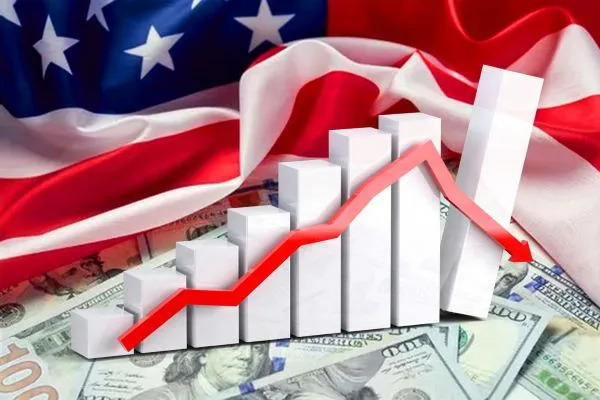
Donald Trump and the Decline of the Global Economic System

by Istishraf International Network
The world has experienced its two deepest global economic recessions since 1960 in the years 2009 and 2020. Yet the recovery from the most recent downturn has been the strongest on record: within five years, global GDP per capita rose to 10 percent above its 2019 level. The rebound in high-income economies was faster than after previous recessions. Although recovery in emerging markets and developing economies outpaced that of high-income countries, it was far slower than during the 2010–2014 period (see charts).
More worrying is that a large number of individual developing countries have performed very poorly in the most recent period. By 2025, GDP per capita exceeded its 2019 level in about 90 percent of high-income economies; by contrast, it remained below 2019 levels in more than a quarter of emerging market and developing economies, and in 40 percent of low-income countries. Worse still, the decline in the share of people living in extreme poverty in the poorest countries has stalled over the past decade. This should concern policymakers worldwide, given that the dramatic reduction in global extreme poverty was one of the great historical achievements.
But who cares in today’s world—one that has become increasingly predatory and openly selfish? Probably not many of those gathering in Davos. So let us turn to what truly matters to them: the global economic outlook in a world subject to the whims of an unhinged strongman. (Yes—his desire to own Greenland borders on madness, and his tariff policies based on personal impulse are authoritarian behavior.) The latest World Economic Outlook report from the International Monetary Fund is reassuring. It states that “global growth is projected to remain steady at 3.3 percent in 2026 and 3.2 percent in 2027, broadly in line with the estimated 3.3 percent outcome for 2025.” This represents a slight upward revision for 2026 and no change for 2027 compared with the October 2025 forecast.
Overall, accommodative monetary and fiscal policies, booming stock markets, and enthusiasm surrounding artificial intelligence have offset both the uncertainty generated by Trump and the negative effects of tariffs—which themselves have been far less aggressive than those announced on “Liberation Day” last April.
So, despite all the noise, could the Trump era amount to nothing more than “a tale told by an idiot, full of sound and fury, signifying nothing”—at least economically? He has learned that he cannot bully China. He believes he can bully everyone else, and so far nothing suggests he is wrong. The costs of his ventures in Venezuela and similar escapades appear limited. In short, the upside may be modest—but so may the downside: his bark may be worse than his bite.
Yet I believe this reassurance is misplaced. What we are witnessing is a slow-motion erosion of the operating systems that underpin both the global economic and political orders.
As the United States becomes increasingly unpredictable and uncommitted to any fundamental principles of conduct—beyond the pursuit of short-term gains—its credibility as a reliable partner and ally is being destroyed, possibly permanently. Domestically, the rule of law, financial stability, the independence of the Federal Reserve (and thus monetary and financial stability), and respect for science are all being called into question. Internationally, the United States is waging war on many major institutions, particularly the European Union. The World Trade Organization has been rendered ineffective. Cooperation on climate and health has withered. Altogether, the administration has announced its withdrawal from a total of 66 international organizations, including 31 entities affiliated with the United Nations.
Even such a non-cooperative and unstable environment may not immediately weaken the willingness of businesses and policymakers to bet heavily on the future—witness the artificial intelligence boom. But this assumption is questionable. The costs may not emerge quickly or even visibly. Still, we know that populist policies undermine domestic economic performance. It is certain that the same will hold true when the system in question is a global superpower. In this case, the damage will extend to the world economy as well, through the loss of many global public goods—including potentially the international roles of the U.S. dollar and the American financial system.
At the same time, as the post-pandemic recovery demonstrates, the global economy possesses enormous momentum: it has, after all, grown in every year since 1950. Major innovations continue to emerge—not only in the United States, but elsewhere too. Adam Smith famously observed that “there is a great deal of ruin in a nation.” He was right. But it would be morally grotesque to test this resilience to the point of destruction—whether for the United States or for the world as a whole.
Most read