China's Strategic Infrastructure Expansion in Peru: Economic Partnership or Geopolitical Leverage?

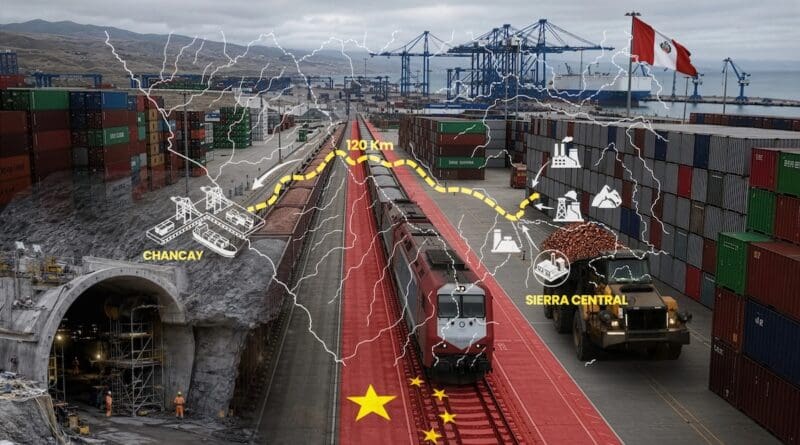
China's expanding infrastructure investments in Peru have become increasingly significant not merely because of their economic scale, but because they embody Beijing's broader strategy to consolidate its presence across Latin America through logistics, transportation, and critical supply chains. The latest railway project connecting the Port of Chancay with Peru's mineral-rich central highlands illustrates how infrastructure has evolved from a development instrument into a central component of geopolitical competition.
While Peruvian authorities portray the project as a catalyst for economic growth and export competitiveness, the initiative has generated growing debate among analysts over the long-term implications of China's expanding influence in strategic sectors of the Peruvian economy. The central question is no longer whether Chinese investment benefits Peru's development, but whether such investments gradually reshape the country's economic dependencies and strategic autonomy.
Infrastructure as a Strategic Instrument
In early 2026, Peru awarded China's Power Construction Corporation of China (POWERCHINA) a $420 million engineering, procurement, and construction contract to build a 120-kilometer railway linking the Port of Chancay on Peru's Pacific coast with the inland regions of Junín, Huancavelica, and Pasco.
Officially, the railway is designed to facilitate the movement of mineral exports—particularly copper—to international markets while improving domestic connectivity and reducing transportation costs. For Peru, whose mining sector remains one of the principal pillars of its economy, improved logistics could substantially enhance export competitiveness and strengthen integration between the country's coastal and Andean regions.
Yet beyond these immediate economic benefits lies a broader strategic reality. Rather than representing an isolated infrastructure investment, the railway forms part of an integrated logistics network linking mineral production, transportation corridors, deep-water ports, and maritime shipping routes under a framework in which Chinese state-owned enterprises occupy key positions.
Building Integrated Supply Chains
The Chancay–Sierra Central railway is expected to transform the transportation of minerals extracted from Peru's central Andes. Instead of relying primarily on highways—where transport can take well over eighteen hours—the new rail corridor will provide a faster and more efficient route directly to the Port of Chancay for shipment to Asian markets.
From an economic perspective, this reduces logistical costs and increases export efficiency. However, from a geopolitical standpoint, it strengthens China's ability to secure long-term access to strategic minerals essential for advanced manufacturing, renewable energy technologies, electric vehicles, and semiconductor production.
Copper, lithium, and other critical minerals have become indispensable components of the global technological competition. Consequently, infrastructure that guarantees reliable access to these resources increasingly carries strategic importance extending far beyond commercial considerations.
The project also complements the operations of major Chinese mining companies already established in Peru, including Chinalco and other Chinese-owned mining assets, thereby creating a vertically integrated supply chain that spans extraction, transportation, port operations, maritime shipping, and ultimately industrial production in China.
Chancay Port: A New Pacific Gateway
At the center of this emerging logistics architecture stands the Port of Chancay, operated by the Chinese state-owned shipping giant COSCO Shipping.
Far more than a conventional commercial port, Chancay is rapidly evolving into one of South America's most important logistics hubs, designed specifically to facilitate direct maritime trade between Latin America and Asia while reducing dependence on traditional shipping routes that pass through North American logistics networks.
For Beijing, Chancay represents a critical component of the Maritime Silk Road under the Belt and Road Initiative. By integrating ports, railways, mining operations, and maritime transport, China is constructing an increasingly interconnected commercial ecosystem capable of supporting long-term trade expansion throughout the Pacific basin.
Such integration enhances China's ability to secure strategic supply chains while reducing transportation costs and increasing the resilience of its overseas resource networks.
Between Economic Opportunity and Strategic Dependence
Supporters of Chinese investment argue that Peru has long suffered from inadequate infrastructure and insufficient foreign investment, making Chinese financing an important catalyst for modernization.
Indeed, Chinese capital has played a significant role in expanding transportation infrastructure, mining production, energy development, and industrial capacity across Peru. Improved logistics may increase export revenues, stimulate regional development, and create new employment opportunities.
However, critics caution that the growing concentration of Chinese investment within strategically important sectors creates structural dependencies that may prove difficult to reverse.
Unlike traditional foreign direct investment, many Chinese infrastructure projects combine financing, engineering, construction, operation, and maintenance under the same group of Chinese state-owned enterprises. This model grants Beijing influence not only over physical assets but also over the operational management of critical logistics networks.
As Chinese companies simultaneously control mines, transportation corridors, ports, and shipping services, questions inevitably arise regarding market competition, national resilience, and the concentration of strategic infrastructure under foreign management.
The Security Dimension
The expansion of Chinese infrastructure has also intensified debate regarding its potential security implications.
Some policymakers in the United States have expressed concern that facilities such as the Port of Chancay could eventually possess dual-use capabilities, allowing commercial infrastructure to support military logistics under certain circumstances. Although no evidence currently indicates that Chancay serves military purposes, such concerns reflect the increasingly blurred distinction between commercial infrastructure and strategic assets in contemporary geopolitics.
Modern deep-water ports, railways, digital communications systems, and logistics hubs frequently possess characteristics that make them valuable during both peacetime commerce and potential security contingencies.
Consequently, Washington increasingly evaluates Chinese overseas infrastructure projects through the broader lens of strategic competition rather than purely commercial investment.
Peru at the Center of Great-Power Competition
Peru now occupies an increasingly important position within the evolving geopolitical landscape of the Indo-Pacific and Latin America.
China has become Peru's largest trading partner and one of its most significant foreign investors. At the same time, the United States continues to view Latin America as a region of enduring strategic importance.
This dual reality places Lima in a delicate position. On one hand, it seeks continued Chinese investment to accelerate economic development and infrastructure modernization. On the other, it must avoid becoming entangled in intensifying strategic competition between Washington and Beijing.
For Peru, maintaining strategic flexibility may prove more important than choosing sides. Preserving diversified economic partnerships while strengthening domestic regulatory institutions could enable the country to maximize investment opportunities without compromising long-term strategic autonomy.
Beyond Peru: A Regional Strategy
The Chancay railway should also be understood within China's broader regional strategy rather than as a standalone project.
Across Latin America, Beijing has steadily expanded investments in ports, railways, highways, telecommunications, renewable energy, electricity transmission, mining, and digital infrastructure. These investments increasingly complement one another, creating interconnected logistics corridors capable of facilitating trade throughout the region.
Rather than seeking immediate political influence, China appears focused on building enduring economic ecosystems that gradually increase regional interdependence with Chinese markets, technology, financing, and transportation networks.
This model differs significantly from traditional geopolitical competition centered on military alliances. Instead, influence is exercised through supply chains, investment, infrastructure ownership, technology transfer, and long-term commercial integration.
Conclusion
The Chancay–Sierra Central railway represents far more than a transportation project linking Peru's mining regions to the Pacific coast. It reflects the emergence of infrastructure as one of the principal instruments through which geopolitical influence is exercised in the twenty-first century.
For Peru, the project offers tangible economic opportunities through improved logistics, increased exports, and enhanced regional connectivity. Yet it also raises legitimate questions regarding the long-term governance of strategic infrastructure, economic resilience, and national sovereignty.
Ultimately, the significance of China's expanding presence in Peru will not be determined solely by the scale of its investments, but by Lima's ability to maintain balanced international partnerships, preserve effective oversight of strategic assets, and ensure that infrastructure development serves national priorities without creating excessive dependence on any single external power. As global competition increasingly shifts from military confrontation to control over trade routes, logistics networks, and critical mineral supply chains, Peru is becoming an increasingly important arena in the evolving strategic rivalry between China and the United States.
Most read



Read also