
The latest position adopted by the BRICS group toward the war in the Middle East points to a gradual shift in the role the grouping seeks to play within the international system. For years, BRICS was viewed primarily as an economic cooperation framework for emerging powers. Yet major geopolitical crises are increasingly forcing the group to test its ability to formulate common political positions on issues extending beyond trade and development to international security, energy and freedom of navigation.
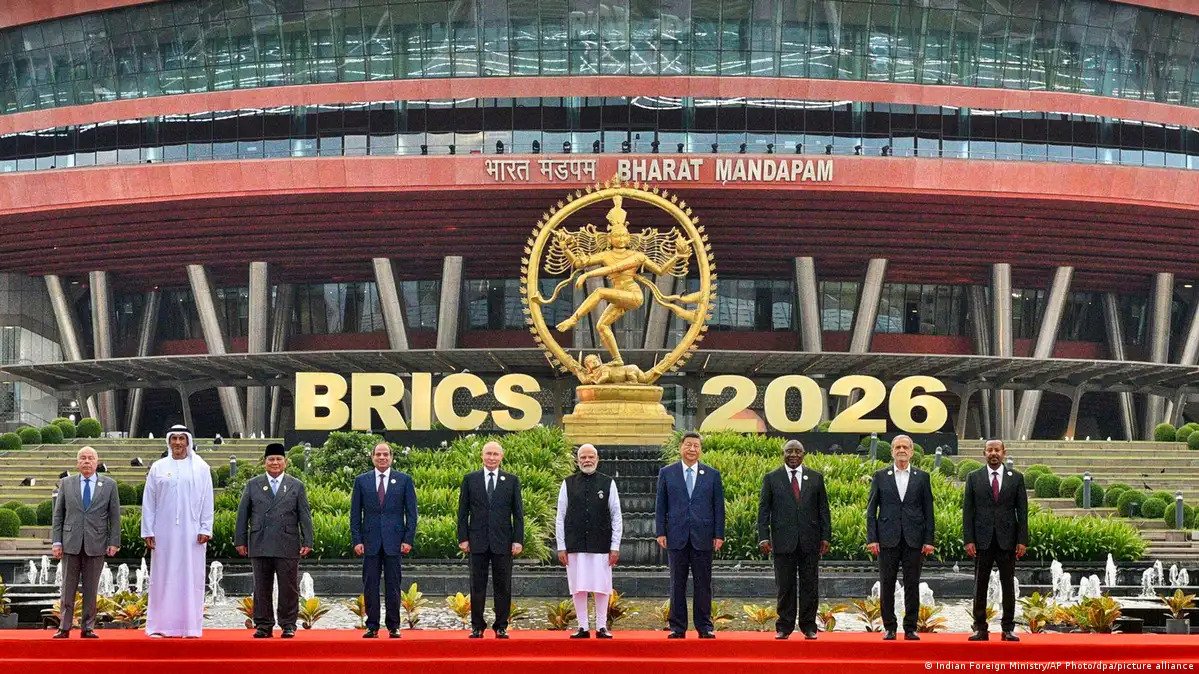
At the BRICS summit in New Delhi, member states called for “the utmost restraint” in the Middle East and warned against actions that could further escalate the situation. Although the language was deliberately diplomatic and cautious, its political significance lies in the fact that it was issued by a grouping that brings together countries with sharply divergent positions on the parties to the conflict, including China, Russia, India, Iran, Saudi Arabia, the United Arab Emirates and Egypt.
This divergence highlights one of BRICS’ central challenges: How can the group move from being a coalition of non-Western states to becoming a political force capable of producing collective positions without allowing differences among its members to paralyze its ability to act?
From Divergence to a Minimum Common Ground
The BRICS call for restraint is particularly significant given the failure of the group’s foreign ministers to reach a joint statement in May concerning the war. That failure demonstrated how difficult it is to produce a common position when the immediate national interests of BRICS members intersect with highly sensitive international conflicts.
The New Delhi summit, however, suggested that the continuation of the war and the widening of its economic and security consequences may have encouraged members to search for common ground, even if that common ground remains limited.
The emerging consensus was not based on a unified interpretation of the war, but rather on several broad principles: opposition to attacks on civilian infrastructure, protection of nuclear facilities subject to international safeguards, respect for nuclear safety and security standards, and avoidance of actions that could increase the likelihood of a wider conflict.
In this sense, BRICS appears to have chosen consensus around managing the risks of war rather than consensus over its causes or responsibility. For a grouping containing states with competing strategic interests, this is arguably the more realistic formula.
Nuclear Facilities and Energy: Common Red Lines
BRICS’ position on nuclear facilities is one of the most significant elements of the joint statement because it moves the group beyond political concern toward the defense of principles directly linked to international security.
Attacks on nuclear facilities carry not only military risks but also potentially severe environmental and humanitarian consequences. They can also undermine the international safeguards system administered by the International Atomic Energy Agency. BRICS’ emphasis on nuclear safeguards and safety therefore reflects a recognition that continued military escalation could transform the Iranian conflict from a regional confrontation into a broader challenge to the international non-proliferation regime.
An important distinction should nevertheless be made. Iran’s membership in BRICS does not mean that the group has become an unconditional defender of Tehran’s policies. At the same time, the membership of Saudi Arabia, the UAE and Egypt does not mean that these countries are prepared to adopt a fully Western position toward Iran.
What these states share is a common interest in preventing the war from becoming an open-ended regional conflict, particularly because Gulf states, Egypt and India would be among those most exposed to disruptions in energy supplies, maritime transportation and global supply chains.
China Seeks a Role Beyond Traditional Mediation
China appears to be the member most willing to give BRICS a political function extending beyond economic cooperation. Chinese President Xi Jinping called on the grouping to act as a “peacemaker” in the Middle East, arguing that the continuation of the war does not serve the common interests of the international community.
This position should be viewed within the broader context of China’s foreign policy. Beijing has increasingly sought to present itself as a global power capable of offering alternatives to Western-led approaches to conflict management.
China’s role in Middle Eastern diplomacy has strengthened this image, most notably through its involvement in the 2023 Saudi-Iranian agreement to restore diplomatic relations. Xi’s call for BRICS to contribute to peace therefore has implications beyond the current conflict: it is also part of a broader effort to portray the grouping as a mechanism for reshaping global governance.
Yet China faces a difficult question: Can Beijing use BRICS as a platform for mediation without making the group appear to be merely an instrument of Chinese foreign policy?
India: The Most Complex Balancing Role
India occupies a distinctive position. It is hosting the summit while maintaining strategic ties with the United States, close relations with Russia, and expanding economic and strategic interests with both Gulf states and Iran.
For this reason, New Delhi’s success in bringing different positions closer together represents a diplomatic gain for India as much as for BRICS itself. India does not want geopolitical disagreements to undermine the grouping, but it also has little interest in turning BRICS into an anti-Western alliance.
This balancing approach reflects the broader character of Indian foreign policy, which increasingly relies on multiple strategic partnerships rather than complete alignment with a single bloc.
India may therefore be one of the countries best positioned to push BRICS toward a pragmatic model: a grouping with growing political influence that does not become a military or ideological alliance.
The Gulf States and Egypt: Interests Before Alignment
The membership of Saudi Arabia, the UAE and Egypt marks an important change in the composition of BRICS. The group is no longer simply a coalition of emerging economies led by China, Russia and India; it now includes Arab states with significant economic, geographic and strategic weight.
These countries have a direct interest in containing the war. Disruptions to navigation in the Gulf and Red Sea, or attacks against energy facilities and infrastructure, could affect oil exports, energy prices, global trade and supply chains.
The positions of Riyadh, Abu Dhabi and Cairo within BRICS can therefore be understood as part of a broader policy aimed at reducing regional risks while preserving strategic room for maneuver.
These states are not necessarily seeking to replace their partnerships with the United States with partnerships with China and Russia. Rather, they are expanding their strategic options and avoiding dependence on a single geopolitical camp.
From this perspective, the participation of Arab states in BRICS forms part of a broader redistribution of influence within the international system, rather than simply representing the economic expansion of the grouping.
Energy and Supply Chains: The Factor Forcing Rivals to Cooperate
Behind the diplomatic language of the joint statement lies a direct economic interest. BRICS emphasized the importance of maintaining the smooth flow of global trade, supply chains and energy.
This point may be more consequential than the general political language because the war is increasingly affecting the infrastructure on which the global economy depends.
The Middle East is not merely a zone of political conflict. It is also one of the world’s most important centers of energy production and global trade routes. Prolonged disruptions to strategic waterways, oil and gas facilities, or pipeline infrastructure could raise transportation and energy costs, intensify inflationary pressures and weaken economic growth.
Here, the interests of BRICS members clearly intersect. China and India are among the world’s largest energy importers, while Russia, Iran, Saudi Arabia and the UAE are major producers or central actors in global energy markets. Regional stability is therefore not simply a security concern for Middle Eastern states; it is also a shared economic interest within BRICS.
BRICS Is Not a Unified Alliance
Nevertheless, interpreting the New Delhi statement as the beginning of BRICS’ transformation into a cohesive political alliance would be an exaggeration.
The group continues to include states with very different views of the international order and sharply different relationships with the United States, Europe, Russia and China. Its expansion has also made collective decision-making more complicated by introducing competing regional interests and divergent economic and security priorities.
BRICS’ strength therefore does not necessarily lie in its ability to produce unified positions on every crisis. Rather, its potential lies in creating a negotiating space that brings together powers that do not necessarily agree on policy but share an interest in reforming the international system and reducing the dominance of a single center of power.
From this perspective, internal diversity is not necessarily an absolute weakness; it may be part of the group’s character as a genuinely multipolar framework.
From Economic Weight to Political Influence
The evolution of BRICS points to a gradual transition from an economic project toward a broader platform for political influence. The group was established in 2009 as a framework for coordination among emerging economies before expanding to include countries such as Egypt, Ethiopia, Indonesia, Iran and the UAE.
As its membership has expanded, so too has its potential to represent a broad segment of the Global South, giving it growing weight on issues ranging from trade and energy to finance, development and reform of international institutions.
Economic weight, however, does not automatically translate into political influence. Political power requires institutions, decision-making mechanisms, the ability to implement initiatives and a sufficient degree of consensus among members.
China’s upcoming presidency of the group and its hosting of the 19th BRICS summit will therefore provide an important test of whether Beijing intends to promote more effective institutional mechanisms or focus primarily on strengthening political and economic coordination among members.
Three Possible Trajectories
The evolution of BRICS’ position toward the Middle East war can be viewed through three possible trajectories.
First: BRICS as a platform for de-escalation.
Under this scenario, China, India and the Arab members could use the group’s internal diversity to encourage de-escalation and protect energy supplies, maritime navigation and critical infrastructure. BRICS would not replace the United Nations or direct negotiations, but could become an additional channel for political communication.
Second: BRICS as a platform for challenging Western dominance.
Continued warfare and growing tensions with the United States could push China, Russia and Iran toward using the group more explicitly to criticize the U.S.-led international order. Such a trajectory, however, could complicate the ability of countries such as India, Saudi Arabia, the UAE and Egypt to maintain balanced relations with Western powers.
Third: BRICS as a multi-interest framework.
This is arguably the most realistic scenario in the near term. The group would continue to avoid issues on which agreement is impossible while focusing on areas where members have common interests, including energy, trade, supply chains, finance and development.
Conclusion
The New Delhi statement does not eliminate the divisions within BRICS, but it reveals an important evolution in the way the grouping approaches international crises. The group moved from failing to issue a common position in May to establishing a limited consensus around de-escalation, protection of civilian and nuclear facilities, and the stability of global trade and energy flows.
The significance of this development lies in the fact that BRICS now brings together countries positioned at the center of global geopolitical and economic dynamics. China, Russia, India and Iran, alongside Saudi Arabia, the UAE and Egypt, possess not only substantial economic weight but also significant influence over energy markets, global trade and strategic transportation routes.
The real test for BRICS, however, will not be its ability to issue statements calling for restraint. It will be its ability to turn this limited consensus into diplomatic and economic instruments capable of influencing the course of international crises.
The Middle East war could therefore become a decisive test for BRICS’ future: will it remain a broad framework for coordination among emerging powers, or gradually evolve into one of the centers of decision-making in an increasingly multipolar international system?
Most read