
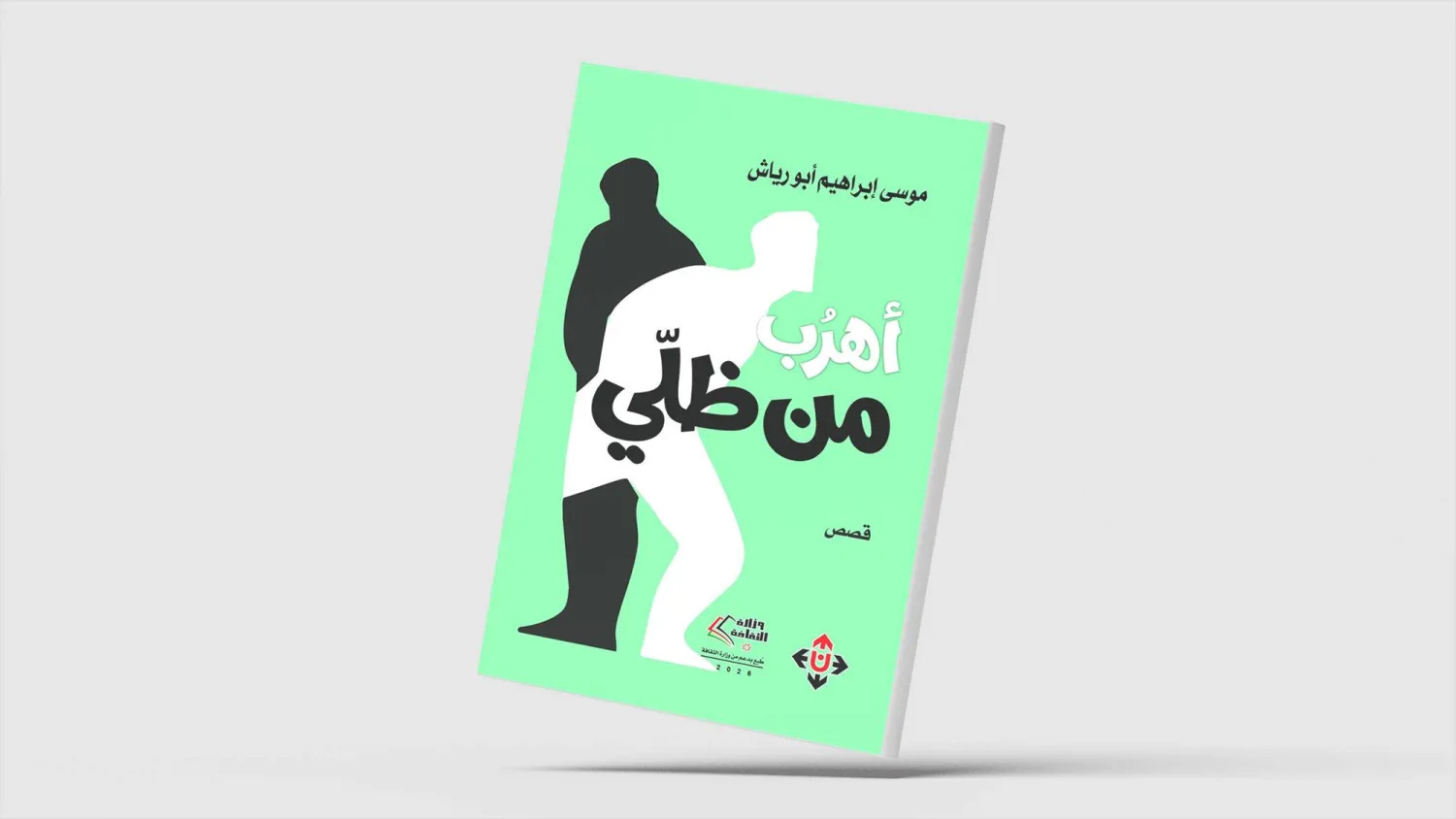
A new short story collection titled Escaping My Shadow by Jordanian writer Mousa Ibrahim Abu Rayash has recently been published by Now Publishers & Distributors in Amman, with support from Jordan's Ministry of Culture.
The 128-page collection comprises fifteen stories exploring a broad spectrum of human concerns, including isolation, alienation, existential anxiety, fear, memory, aging, illness, death, identity, the fragmentation of the self, justice, family relationships, and bureaucracy. While engaging with the dilemmas of contemporary society, the stories never lose sight of their profound human dimension or their preoccupation with the individual's existential destiny.
Rather than following the conventions of linear storytelling—with a clear beginning, middle, and end—Escaping My Shadow adopts a narrative structure in which ideas serve as the primary driving force behind events. Each story unfolds as though it were an existential question embodied in narrative form, or a psychological experience searching for its artistic expression. As a result, reading the collection becomes less a journey through plot than an exploration of the inner landscapes of its characters.
The collection displays a pronounced inclination toward irony and the uncanny, while drawing extensively on elements of nightmares, dreams, fantasy, and psychological realism. The boundaries between reality and imagination become deliberately blurred, inviting readers to reinterpret both events and characters long after they have finished reading.
Symbolism functions not merely as an aesthetic embellishment but as a fundamental structural device. Shadows, mirrors, windows, cities, roads, collapse, labyrinths, staircases, containers, and clocks are never neutral objects; instead, they evolve into symbols that transcend their material existence to evoke identity, memory, fear, disorientation, and the divided self. Consequently, the stories invite not only realistic readings but also symbolic, psychological, and philosophical interpretations.
The collection is distinguished by its concise and economical language, carefully crafted surprise endings, and a calm narrative rhythm that gradually builds toward moments of profound significance. Abu Rayash relies more on suggestion and symbolism than explicit statement, allowing the texts to remain open to multiple interpretations and encouraging readers to participate actively in the construction of meaning.
Internal monologue is one of the defining techniques of the collection. Indeed, it may be said that the true dialogue is not between the characters but between each individual and the self. The characters think far more than they speak; they constantly scrutinize themselves and reinterpret the world around them. As a result, most events seem to unfold first within consciousness before manifesting in external reality. This psychological depth transforms readers from passive observers into active participants in shaping the meaning of the stories.
The collection's cover was designed by artist Eid Banat. It is Abu Rayash's fourth collection of short stories, following The Butterfly (2017), The Hidden Camera (2021), and The Last Call (2025). He is also the author of the critical volume On the Banks of Narrative: Readings in the Short Story and the Novel (2021).
From the title story, Escaping My Shadow:
"A few days ago, an angry man stopped me and demanded sharply, 'You! Why did you step on my shadow? That is an unforgivable insult. Anyone who steps on my shadow is as though he has stepped on me. Are you blind, or did you do it deliberately?'
I apologized sincerely and explained that I had been walking absent-mindedly, burdened with worries, and had failed to notice his esteemed shadow. I asked for his forgiveness and assured him that I had never intended to offend him; after all, there was neither enmity nor even prior acquaintance between us.
The man's anger gradually subsided. Sensing that I was sincere, he finally said, 'I forgive you. Go your way—and watch your step. You have escaped me today, but you may not escape someone else.'"
Originally published in Asharq Al-Awsat.
Most read