
Can poetry transform the intellectual structure of society? Was classical Arabic poetry able to impose its aesthetic vision and artistic values within a complex and deeply challenging social environment, enabling the poem to create an ideal world that transcended the harsh realities endured by individuals crushed under patriarchal authority and constrained by superstition, magic, inherited customs, and deeply rooted traditions?
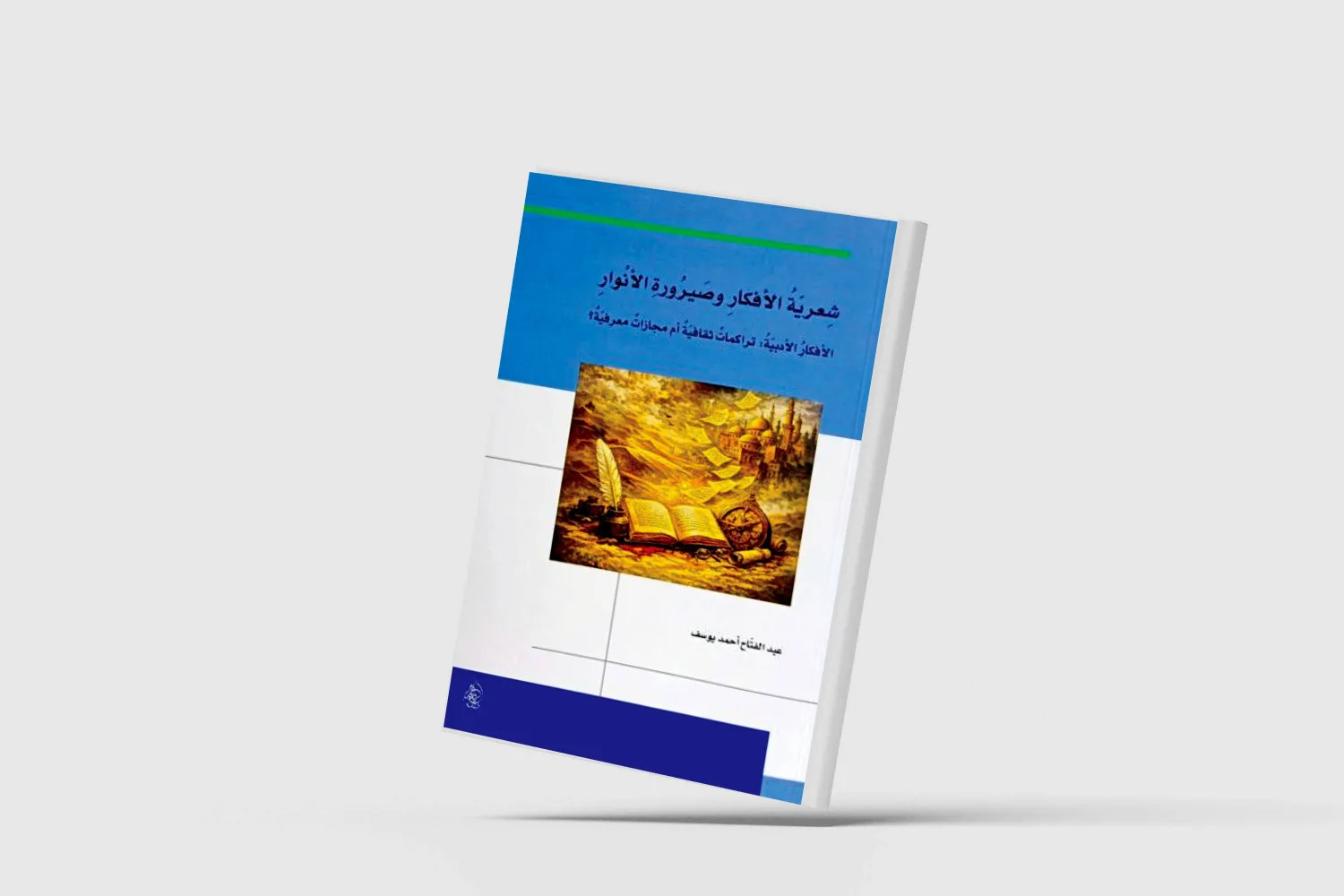
These are among the central questions explored in The Poetics of Ideas and the Becoming of Enlightenment by Dr. Abdel Fattah Ahmed Youssef, Professor of Literature and Modern Critical Studies at the College of Arts, University of Bahrain. The book carries the revealing subtitle Literary Ideas: Cultural Accumulations or Cognitive Metaphors?, posing a broad inquiry into the nature of poetry, literary thought, and their role in shaping the social fabric. It was recently published by Dar Al-Rawafed Al-Thaqafiya in Beirut.
The book traces the development of Arabic poetics from its earliest documented beginnings, starting with the poetry of the pre-Islamic (Jahiliyyah) era. It closely examines celebrated poets of the Mu'allaqat, including Zuhayr ibn Abi Sulma, Imru' al-Qays, Antarah ibn Shaddad, and Al-Muhalhil (Adi ibn Rabi'ah), better known as Al-Zeer Salem.
Employing a methodological framework informed by post-structuralist thought, the author explores how literary ideas are articulated through creative expression. He argues that these poets articulated universal human values that transcended tribal prejudice, discrimination, and racial divisions, seeking to present an idealized vision of the world through poetry. In this sense, poetry becomes an artistic medium capable of weaving together reality and imagination into a unified fabric that gradually permeates collective consciousness, allowing new ethical ideals to take root over time.
Antarah ibn Shaddad offers one of the clearest examples of this enlightened vision. His poetic rebellion against his status as a Black slave, together with his determination to win both his freedom and the hand of his beloved Abla, embodies values of perseverance, resistance, and defiance of the patriarchal order that governed pre-Islamic Arab society and reinforced the binary of master and slave. Through his verse, Antarah opened new horizons for heroism, courage, and self-determination, advancing an enlightened discourse that challenged outdated traditions and rejected submission to an unjust social reality.
A similar spirit is evident in the poetry of Zuhayr ibn Abi Sulma, whose works consistently championed noble humanitarian values. He condemned the endless tribal wars that erupted over the most trivial causes and often lasted for decades. His call for peace and reconciliation was not merely a moral or religious appeal against violence; rather, it represented a broader humanistic principle that occupies a central place within the wider Enlightenment tradition. These values would later be further developed by poets of the early Islamic period, as well as during the Umayyad and Abbasid eras.
Across its five chapters, the book examines the relationship between the poetic self and the Enlightenment aspirations embedded within classical Arabic poetry. It highlights how patriarchal social authority promoted particular values that poets often reinforced through genres such as panegyric and love poetry. Yet, alongside these conventional voices emerged poets who challenged prevailing norms by constructing an alternative poetic discourse that sought to establish new Enlightenment ideals. Among the most significant of these was the elevation of knowledge and reason over superstition, fortune-telling, and clerical mysticism—a struggle in which Abu Tammam stood out as one of the leading literary figures.
The study further explores how the Arab poetic self searched for an elevated mode of existence capable of transcending the constraints of lived reality in order to create a broader and more liberating world. Confronting its marginalization within the collective consciousness, this poetic self sought individuality and distinction. Classical Arabic poetry thus became a unique intellectual pathway through which that individuality could be asserted and a transcendent sense of being achieved.
This poetic discourse addressed a wide range of enduring human concerns, including life and death, generosity and miserliness, women, love and beauty, heroism and sacrifice, suffering and happiness, coexistence and tolerance, as well as exclusion and alienation. Within this tradition emerged rebellious literary voices, such as the Sa'alik (brigand poets), physically disabled poets, and other unconventional figures who embraced a provocative poetic discourse that encouraged resistance and challenged social conformity.
Many poets advanced these values within an Enlightenment framework that confronted entrenched ideological systems, rigid value structures, and prevailing cultural prejudices. Figures such as Abu Nuwas, Bashar ibn Burd, and Abu al-'Ala al-Ma'arri paid a heavy personal price for their intellectual and poetic positions. Yet the ideas they championed would later become an integral component of Arab civilization and one of its enduring Enlightenment traditions.
Just as patriarchal society sought to preserve its authority and resist attempts to question its established certainties, poets pursued their own distinctive path toward enlightenment. This path often emerged from the creative self rather than direct confrontation with society. At certain historical moments, royal courts and caliphal palaces also played a significant role in nurturing innovative poetic voices and supporting their intellectual and artistic visions.
In this context, the book points to the influence of the court of Sayf al-Dawla al-Hamdani on the poetic formation of Al-Mutanabbi, the court of Antioch on Al-Buhturi, and the court of the Abbasid Caliph Al-Mu'tasim on Abu Tammam. These examples illustrate that royal patronage often shielded poets from the pressures of patriarchal society, reflecting an awareness among political rulers of the strategic importance of their alliance with literary figures.
According to the author, the literary ideas and Enlightenment aspirations manifested in classical Arabic poetry originated from the interaction between reason and imagination. It is precisely this synthesis that endowed poetry with the capacity to break away from dominant modes of thought, generate new forms of knowledge, and ensure the enduring continuity of its intellectual legacy throughout history.
According to Asharq Al-Awsat.
Most read