
Tunisia is entering a delicate phase in which social and economic pressures intersect with prolonged political deadlock, placing the current system under mounting strain and simultaneously raising serious questions for its international partners—foremost among them Washington—about how to deal with a reality that appears increasingly unsustainable in the long term. As internal pressure on President Kais Saied intensifies, an external approach limited to managing security crises is no longer sufficient. Instead, there is growing need for restrained yet forward-looking steps that could help prevent further deterioration and open broader economic and social horizons.
A Year of Rolling Protests
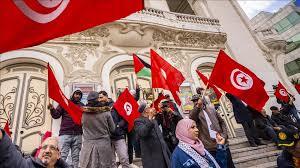
Over the past year, Tunisia has witnessed a notable surge in protest activity, driven by a mix of economic and social demands, political grievances, and local environmental concerns. Available data indicate thousands of protest actions since the beginning of the year—a sharp increase compared to the previous year—with particularly high concentrations in the second half of 2025.
A key development has been the return of traditional actors to the streets, especially the Tunisian General Labour Union (UGTT), despite its declining credibility in recent years due to fluctuating positions toward the authorities. The August mobilizations demonstrated that the presidency still views the union as a potential threat, given its organizational weight and historical capacity for mass mobilization.
Even more significant were the environmental protests that erupted in the city of Gabes following severe health deterioration caused by industrial pollution. What began as localized demonstrations—initially met with security repression—quickly evolved into a broader movement that temporarily paralyzed the governorate through a general strike. These events once again highlighted a chronic crisis involving major state-owned enterprises, which simultaneously function as economic pillars and persistent sources of social unrest, amid the state’s failure to implement promised reforms or relocate polluting facilities.
The Gabes protests carry added significance as they may signal the rise of environmental activism in Tunisia, particularly in a region historically sensitive to labor and social unrest. Although the movement was partially contained, official anxiety over its potential spread to other areas remained evident.
Parallel Political and Judicial Escalation
Alongside social protests, Tunisia has experienced renewed political mobilization in response to harsh judicial verdicts issued against dozens of opposition figures in the so-called “conspiracy against the state” case. These lengthy prison sentences triggered widespread human rights criticism and weekly protests, raising the prospect of a more sustained movement targeting the judiciary and its perceived political instrumentalization.
In another episode, clashes in the city of Kairouan following the killing of a citizen by police underscored the fragility of relations between security forces and segments of society, within a broader climate marked by shrinking freedoms and mounting pressure on civil society.
Growing Discontent—Without Imminent Collapse
Despite the accumulation of these signs of unrest, Tunisia does not appear on the verge of an immediate political or economic breakdown. Protest culture has been embedded in public life since 2011, and popular frustration has persisted for years—particularly since the extraordinary measures taken by the president in 2022. A crucial additional factor is the widespread preference among many Tunisians, especially skilled youth, for emigration over open confrontation with the authorities. This deepens the brain drain crisis and weakens the capacity for sustained mass mobilization.
Yet this form of “negative stability” is not without risk. Continued economic deterioration, combined with the possibility of sudden unrest or a power vacuum, makes it imperative for external partners—particularly Western ones—to consider unconventional scenarios.
What Can Be Done Externally?
Against this backdrop, a reassessment of the U.S. approach toward Tunisia is increasingly necessary. Rather than focusing narrowly on security management or countering the presidency’s outreach to Washington’s rivals, the United States could adopt limited but strategically meaningful economic and political steps.
Despite Tunisia’s small size and complex domestic politics, its geographic position, strong ties to Europe, and relatively young working-age population give it potential relevance in global supply chains—provided genuine economic reform space is created. Past experience also suggests that the current leadership, despite its sovereignty-focused rhetoric, remains sensitive to carefully calibrated Western pressure.
Accordingly, Washington could help ease economic strain by supporting trade infrastructure projects, encouraging investment in less politicized sectors, and implementing low-cost yet high-symbolism measures such as revising tariffs on Tunisian exports. Backing donor efforts—particularly in the energy sector—could further stabilize conditions and send reassuring signals to Tunisian public opinion.
Beyond Crisis Management
Ultimately, the core challenge lies not merely in preventing collapse but in helping Tunisians recover a shared horizon for a more prosperous future. The post-2011 experience demonstrated that external support, when translated into tangible and symbolically meaningful initiatives, can strengthen public confidence in the possibility of change. Reviving this dynamic requires international partners—especially Washington—to move beyond crisis containment toward long-term political and economic investment in stability.
Most read



Read also