Trump’s Revised Plan to End the Gaza War: From Conflict Management to the Reproduction of Israeli Hegemony
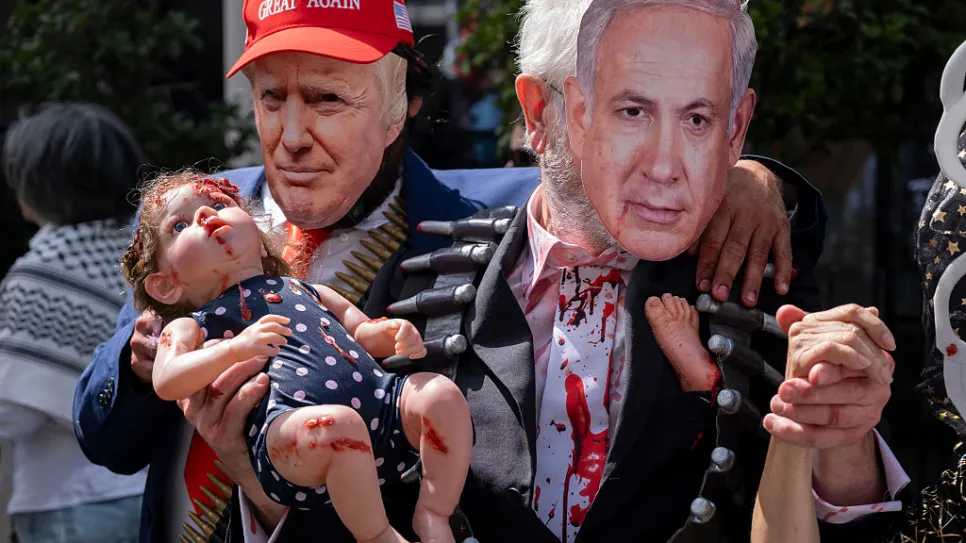
The Revised U.S. Plan: From an Alleged Peace Initiative to a Tool for Subjugating Palestinians and Consolidating Israeli Dominance
A Proposal for Submission, Not Negotiation: The Plan as an Invitation to Surrender in Exchange for Hollow Promises
Amid the ongoing Israeli war on the Gaza Strip, which has now entered its third year, U.S. President Donald Trump announced a new proposal for a “peace” and ceasefire plan in coordination with Israeli Prime Minister Benjamin Netanyahu during a joint press conference on September 29, 2025. The announcement was accompanied by threats of decisive and painful measures should Hamas reject the proposal, which consists of twenty provisions, despite the fact that the movement was neither involved in drafting the plan nor consulted about its details.
Following the announcement, the Qatari and Egyptian mediators delivered a copy of the proposal to Hamas leadership. The movement pledged to examine it with what it described as “a high sense of responsibility” and to provide an official response after consultations with other Palestinian factions.
Although the Palestinian Authority cautiously welcomed the plan, and several Arab and Islamic countries expressed willingness to support it—despite the fact that it largely reflects Israeli conditions—its implementation still faces major obstacles. Among the most significant are the demand to dismantle Hamas’s organizational structure and disarm the movement, the ambiguity surrounding the mechanism and timeline of Israeli withdrawal from the Gaza Strip, Netanyahu’s rejection of the idea of a Palestinian state and his insistence on maintaining security control over Gaza, as well as the absence of clear guarantees for the implementation of the plan’s provisions.
The proposal essentially incorporates Israel’s declared objectives in the war, with the added advantage that Netanyahu can claim that Arab and Islamic states have joined him and that Israel’s diplomatic isolation has been broken. Arab and Islamic countries, however, should have insisted on their own conditions just as firmly as Israel did, rather than announcing support for the plan without them.
Details of the Plan
Trump’s plan includes a set of general principles covering most of the key issues related to the Israeli war on the Gaza Strip. These provisions address central issues such as a ceasefire, prisoner exchanges, the gradual withdrawal of Israeli forces, the delivery of humanitarian aid, the reconstruction of Gaza, the disarmament of Hamas, and the establishment of a Palestinian technocratic administration in Gaza under international supervision.
The plan was drafted by U.S. Special Envoy Steve Witkoff and Trump’s former adviser Jared Kushner, in consultation with Israeli Strategic Affairs Minister Ron Dermer and former British Prime Minister Tony Blair. Although consultations took place with representatives of Arab and Islamic countries—who were present in New York for the United Nations General Assembly—their input was ultimately disregarded.
Below are the main provisions of the plan, as published by the White House on the same day as the press conference
1. Ceasefire
An immediate cessation of “hostilities,” under which Hamas would be required within 72 hours of the agreement entering into force to release all Israeli captives in its custody, both living and deceased. The total number is estimated at 48, including approximately 20 believed to still be alive according to U.S. and Israeli estimates.
In return, Israel would release 250 Palestinian prisoners serving life sentences and 1,700 detainees from Gaza who have been arrested since the beginning of the war, including women and children. In addition, Israel would hand over the remains of 15 Palestinians for every Israeli captive’s body returned.
2. Withdrawal of Israeli Forces
A gradual withdrawal of Israeli forces according to a specific timetable and benchmarks linked to the disarmament of Hamas. An international security force would be deployed to take control of areas evacuated by Israeli troops.
3. The Fate of Hamas and Post-War Gaza
Hamas would be excluded from any role in governing Gaza, and its military infrastructure—including tunnels—would be completely dismantled. Amnesty would be granted to members who pledge to live peacefully, while those wishing to leave the Gaza Strip would be allowed to do so.
An international security force would oversee the implementation of disarmament arrangements, ensure compliance, and maintain order. It would also train Palestinian police forces responsible for maintaining internal security.
Although the plan affirms that Israel “will not occupy or annex Gaza,” it also stipulates that Israel will maintain a security presence along Gaza’s borders until the territory is deemed fully secure.
4. Humanitarian Aid and Reconstruction
Humanitarian aid would begin flowing immediately into Gaza according to the agreement reached on January 19, 2025. The plan also includes the rehabilitation of infrastructure, the repair of hospitals and bakeries, and the removal of rubble.
International organizations such as the United Nations and the Red Crescent would oversee the distribution of aid without interference from either side, while the Rafah crossing would be opened in both directions.
The plan affirms that Palestinians will not be expelled from the Gaza Strip and that they will have the freedom to leave and return. It also includes an international commitment to reconstruct Gaza for the benefit of its residents.
5. Interim Administration and the Palestinian Authority
The Gaza Strip would be temporarily administered by a Palestinian technocratic committee composed of non-political figures responsible for public and municipal services. This body would include Palestinian and international experts operating under the supervision of an international body called the “Peace Council,” chaired by Donald Trump himself and including international figures such as Tony Blair.
The council would oversee reconstruction funding until reforms within the Palestinian Authority are completed in accordance with earlier proposals, including Trump’s 2020 peace plan and the Franco-Saudi initiative.
The plan also calls for the creation of a temporary international stabilization force, in cooperation with Jordan and Egypt, tasked with training Palestinian police forces, supporting them, and securing the borders.
6. The Palestinian State
The plan states that as reconstruction progresses and Palestinian Authority reforms are implemented, conditions may eventually be created for a credible path toward Palestinian self-determination and the establishment of a Palestinian state, described as “the aspiration of the Palestinian people.”
An Ambiguous Plan Lacking Guarantees
It appears that Israel succeeded in the final hours before the plan’s announcement in introducing substantial amendments that effectively stripped it of its substance and turned it into a document heavily biased toward Israeli demands. According to a report by the American news website Axios, Israeli Prime Minister Benjamin Netanyahu managed to insert major revisions to the plan during a meeting with Steve Witkoff and Jared Kushner one day before his meeting with Donald Trump. As a result, the final version became far more aligned with the Israeli vision than the initial draft.
The report also indicates that the proposals Trump had presented to leaders and officials from eight Arab and Islamic countries during a meeting on September 23, held on the sidelines of the United Nations General Assembly, differed significantly from the version later announced alongside Netanyahu. This discrepancy generated dissatisfaction among those countries, particularly since Trump portrayed the plan as the outcome of an American–Arab–Islamic consensus, while Hamas’s approval remained the final obstacle to its implementation.
Among Netanyahu’s most significant amendments were those concerning the conditions and timeline for Israel’s withdrawal from Gaza. While Arab and Islamic states had called for replacing the phrase “disarmament of Hamas” with “placing weapons under control,” the final version of the plan explicitly linked Israel’s withdrawal from the Gaza Strip to Hamas’s disarmament and granted Israel the right to object to the mechanisms of implementation.
Netanyahu also appears to have persuaded Trump to maintain an Israeli military presence within what is described as a “security perimeter” inside Gaza for an unspecified period, even if the Palestinian side complies with all the conditions. The plan makes no reference to earlier commitments Trump reportedly made to Arab officials regarding preventing Israel from annexing parts of the West Bank or halting settlement expansion. Nor does it include provisions addressing violations at Al-Aqsa Mosque or calls for an immediate increase in humanitarian aid to Gaza.
The provisions of the plan are marked by ambiguity and a lack of guarantees, while largely satisfying the conditions consistently demanded by Netanyahu. This becomes evident in several key issues, most notably the following:
1. Marginalizing the Goal of a Palestinian State
The plan addresses the idea of a Palestinian state only briefly and in vague terms, describing it merely as an “aspiration of the Palestinian people” rather than as a right or an internationally recognized entitlement. This characterization contradicts the positions of several U.S. allies—including the United Kingdom, France, Canada, and Australia—which view the establishment of a Palestinian state as a fundamental basis for any lasting peace.
Trump even stated that some allies had “foolishly recognized a Palestinian state,” while Netanyahu reaffirmed his categorical rejection of the idea. This suggests that Netanyahu accepted the plan only with reservations and did not declare unconditional approval.
2. Marginalization of the Palestinian Authority
The plan sidelines the Palestinian Authority until it completes what are described as “extensive reforms,” without specifying who will determine its readiness or what criteria must be met. At the same time, it treats the Gaza Strip as a separate entity, in clear disregard of the territorial unity of the Palestinian territories. This approach aligns with Netanyahu’s repeated statements rejecting the return of the Palestinian Authority to Gaza.
3. Ambiguity in the Governance of Gaza
The plan proposes the formation of a “Palestinian committee of non-political technocrats” operating under the supervision of a newly created international body. However, it does not clarify how this committee would be formed or how its members would be selected.
It further stipulates that Trump and Tony Blair would chair the “Peace Council” overseeing this committee, without specifying the council’s powers, its relationship with the committee, or how day-to-day decisions would be made.
4. An Open-Ended Withdrawal
The plan stipulates a gradual Israeli withdrawal from the Gaza Strip according to “benchmarks and timelines linked to disarmament.” However, it does not define these benchmarks or clarify who would determine whether they have been met. This ambiguity leaves the door open for an indefinite delay, particularly since the process of disarmament itself remains unclear: who would carry it out, and who would declare its completion?
5. An International Force Without a Clear Mandate
The plan also refers to the deployment of a “temporary international stabilization force” in Gaza, without specifying which countries would participate, what its precise mission would be, or whether it would perform policing or military roles, including the possibility of confronting Palestinian resistance factions.
In their earlier proposals, the eight Arab and Islamic states had suggested that any international force should be stationed along the borders and that there should be no direct friction between foreign troops and the local population.
Trump’s Motives for Proposing the Plan
Trump’s insistence on presenting a plan to end the war in Gaza appears to stem from a range of personal and political considerations, both domestically and internationally. The timing of the announcement also coincided with a critical moment for both Israel and the United States.
Israel has been facing growing international isolation due to the crimes committed in Gaza, leading to a decline in support from countries traditionally considered its allies, including Canada, Australia, the United Kingdom, France, Belgium, and Spain, along with several other European states. Meanwhile, the United States—through its continued unconditional support for Israel across multiple levels—has increasingly found itself almost alone on the international stage, including within the United Nations Security Council. After France and the United Kingdom joined China and Russia in recognizing a Palestinian state, the United States became the only permanent member of the Council that does not recognize it.
Within American public opinion, a noticeable shift against Israel has also emerged, even within segments of the MAGA movement (Make America Great Again)—Trump’s core electoral base. This shift has placed Trump under increasing pressure, particularly as some figures within the movement have begun questioning whether he remains committed to the slogan “America First” or whether his policies reflect what they perceive as an “Israel First” approach.
Frustration has also grown within Trump’s inner circle due to what was perceived as Netanyahu’s attempts to interfere in U.S. domestic politics. During a meeting at the United Nations on September 26, Netanyahu met with several conservative American social media influencers—many of them supporters of Trump—and asked them to support Israel by “fighting” online on its behalf.
During that meeting, Netanyahu attacked what he described as the “Woke Right” or the “Woke Reich,” using the term “woke” as a political insult and describing them as “crazy and deranged.” He specifically targeted the prominent right-wing broadcaster Tucker Carlson, who has become increasingly critical of Israel. Carlson had recently accused Netanyahu of “boasting about controlling Trump,” a claim Netanyahu denied.
Another factor behind Trump’s initiative was Netanyahu’s decision on September 9 to carry out a strike in Qatar targeting Hamas negotiators in Doha, which resulted in the killing of five Palestinians and a Qatari security officer. The attack reportedly “unified the Gulf voice” and generated mobilizing pressure that prompted Trump’s advisers to renew calls for launching ceasefire negotiations in Gaza.
During his meeting with Trump, Netanyahu reportedly held a phone call with Qatar’s Prime Minister and Foreign Minister Mohammed bin Abdulrahman Al Thani, expressing “deep regret” that the Israeli missile strike against Hamas targets in Qatar had unintentionally killed a Qatari soldier. He also apologized for violating Qatari sovereignty during the hostage negotiations and assured that Israel would not carry out such an attack again.
On a personal level, Trump has repeatedly promoted the idea that he deserves the Nobel Peace Prize, claiming that he ended seven wars within just seven months. He appears to believe that successfully ending the Gaza war could provide him with a major diplomatic achievement, particularly by expanding the Abraham Accords, which he initiated during his first presidential term (2017–2021) between Israel and several Arab and Islamic countries.
In addition, some of Trump’s advisers warned him that Netanyahu was “manipulating” him and showing insufficient respect. This prompted the U.S. administration to send a clear message to Netanyahu indicating growing frustration and urging him to choose between accepting Trump’s plan or risking a public rupture with a president who appeared—perhaps for the first time since returning to office—willing to distance himself from Netanyahu over Gaza.
Netanyahu ultimately chose to avoid a direct confrontation with Trump. Nevertheless, he succeeded in modifying the American plan and undermining the momentum of the U.S. initiative by introducing major changes to it—even though it had already received preliminary approval from Trump and several Arab and Islamic leaders less than a week before his meeting with Netanyahu.
Conclusion
In its revised form—aligned with the Israeli vision—the American plan does not constitute a genuine framework for peace in the Gaza Strip. Rather, it appears closer to an attempt to subordinate the Palestinians, and the region more broadly, to a logic of Israeli dominance and coercive power.
In practice, the plan is not presented to Hamas as a negotiated proposal but rather as an invitation to surrender in exchange for uncertain promises. References to a Palestinian state and an Israeli withdrawal from Gaza are formulated in vague terms, while the plan effectively envisions placing the territory and its population under an open-ended international trusteeship, without a clear timeframe or defined mechanisms.
The plan also lacks credible guarantees for the reconstruction of the Gaza Strip, despite the fact that the international body tasked with overseeing reconstruction is expected to be chaired by Trump himself. In practical terms, the structure of the plan effectively consolidates Israeli control over Gaza for an undefined period under a fragile international cover.
At the same time, Hamas and the Palestinian resistance face an extremely difficult dilemma if they reject the plan. Such a rejection could allow Israel to continue its devastating war against the population of the Gaza Strip with renewed American support, while maintaining the blockade and preventing humanitarian aid from reaching hundreds of thousands of civilians facing hunger and destruction.
Source:
Ultra Palestine
Most read


Read also