The U.S.-China Summit and the Management of Strategic Competition

At the beginning of 1914, the international environment appeared relatively calm. In his memoirs, British Foreign Secretary Edward Grey reportedly observed that the world’s skies seemed clearer during the early months of that year than they had been for some time. Yet that calm proved short-lived. Within months, the First World War had erupted, demonstrating that international stability cannot be measured solely by the absence of direct conflict. It also depends on the ability of major powers to contain accumulating disputes before they develop into broader confrontations.
The historical significance of this experience lies in its reminder that major wars do not necessarily begin with an explicit decision to wage comprehensive war. They can emerge from an accumulation of limited crises, mutual miscalculation, deteriorating communication channels, and the interaction of security interests with political calculations. From this perspective, today’s international environment appears increasingly complex, marked by multiple areas of tension, growing competition among major powers, and mounting pressure on some of the mechanisms traditionally used to manage crises.
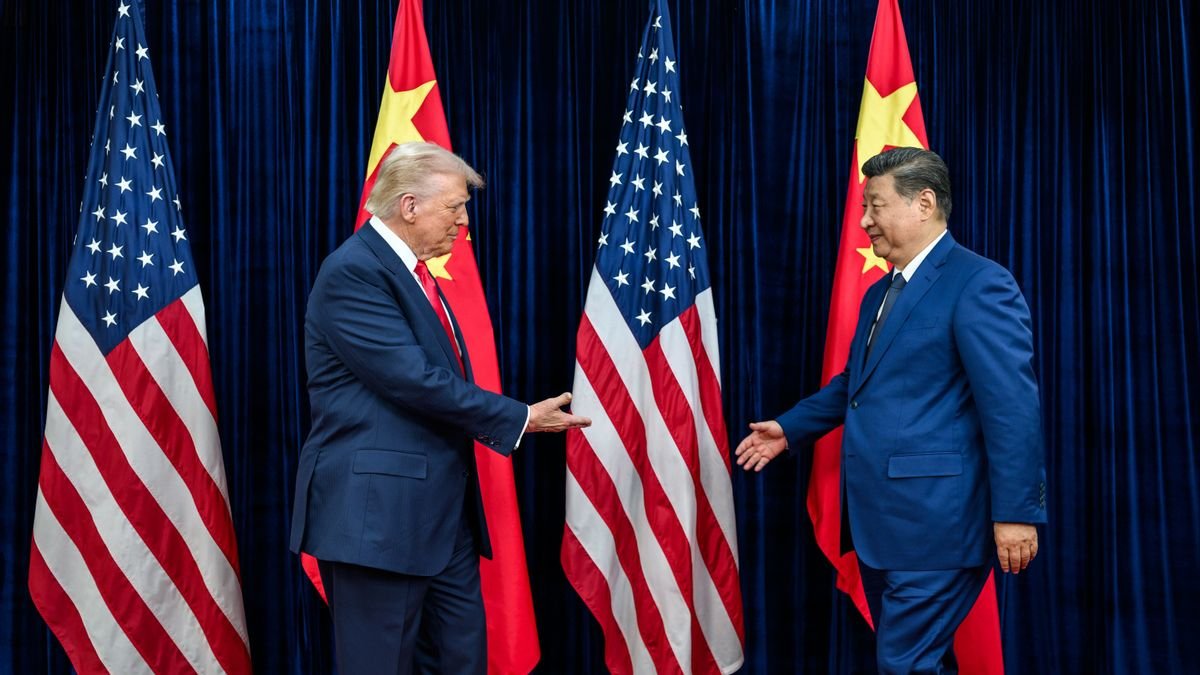
Against this backdrop, the summit between U.S. President Donald Trump and Chinese President Xi Jinping carries significance that extends beyond conventional bilateral issues. The relationship between Washington and Beijing is no longer defined primarily by separate trade disputes or individual security concerns. It has become one of the principal arenas in which the international order is being reshaped, amid competition over economic influence, technological capabilities, strategic power, and the rules governing international relations.
The significance of the summit therefore lies not necessarily in the possibility of reaching a comprehensive agreement, but in whether it can help establish boundaries within which competition can be managed and prevent rivalry from developing into a confrontation that becomes increasingly difficult to control.
Four Maps of U.S.-China Competition
The summit’s agenda can be understood through four interconnected “maps” that capture the principal dimensions of competition between the two powers.
First: The Economic Map
Trade remains one of the most visible arenas of U.S.-China competition, but the underlying dispute has moved well beyond tariffs. Global supply chains, economic security, market access, and control over strategic industries have increasingly become components of a broader conception of national security.
The competition encompasses agriculture, commodities, aircraft, and manufacturing, but it also involves the restructuring of global production networks. The United States is seeking to reduce its dependence on China in sensitive sectors, while Beijing is working to strengthen its capacity to withstand American trade and technology restrictions.
Consequently, any potential trade understanding could reduce tensions without eliminating the strategic forces that are pushing both sides to reconsider the structure of their economic relationship.
Second: The Technology Map
Technological competition is more closely linked to the future than the immediate trade dispute. Artificial intelligence, semiconductors, advanced computing, data centers, quantum computing, and critical minerals and materials have all become components of a broader competition over who will possess the technologies that shape the balance of power in the coming decades.
Semiconductors are particularly important because they lie at the intersection of economics and national security. Advanced chips are essential to artificial intelligence, military applications, and digital industries, making access to, development of, and production of semiconductors strategic concerns.
Competition over rare earth elements and other critical materials adds another dimension. Possessing resources is not sufficient; the ability to extract, process, manufacture, and secure reliable supply chains has itself become an element of geopolitical power.
Technological competition is therefore evolving into a contest over the infrastructure of the twenty-first century rather than simply a rivalry among companies or economic sectors.
Third: The Political and Security Map
The Indo-Pacific represents the most sensitive arena in the U.S.-China relationship because it brings together security interests, military capabilities, and regional alliances. Taiwan is at the center of this equation, alongside the South China Sea, changes in Japanese defense policy, and the evolution of China’s relationship with Russia.
Washington and Beijing hold fundamentally different views regarding the region’s security architecture. The United States seeks to preserve its network of alliances and security partnerships, while China views some of these arrangements as attempts to constrain its strategic space in its immediate neighborhood.
The danger in this domain lies in the possibility that a military confrontation could emerge from a limited incident or miscalculation, particularly in maritime and airspace environments where the forces of the two countries and their partners increasingly operate in close proximity.
For this reason, crisis-management mechanisms and direct military communication may at times be more important than political statements issued at summits, because they provide practical tools for preventing a limited incident from escalating into a strategic crisis.
Fourth: The International-Order Map
U.S.-China competition is not confined to the bilateral relationship. It also extends to the structure and future direction of the international order itself. Washington views China as a major competitor capable of influencing the rules and institutions of the global system, while Beijing continues to expand its economic, political, and diplomatic presence across different regions.
The Middle East, Iran, Latin America, international institutions, trade, energy, and security are all relevant to this broader competition. This does not necessarily mean that China is seeking to replace the existing international order outright. Rather, it reflects its growing capacity to influence the rules, institutions, and networks that underpin that order.
From this perspective, U.S.-China competition is not simply a struggle for regional influence. It is part of a broader redistribution of power within the international system.
The Logic of the Summit: Grand Bargain or Risk Management?
Against this backdrop, expectations of a possible “grand bargain” should be approached cautiously. The issues on the table extend beyond the capacity of a single meeting to resolve them definitively, while disagreements between the two countries are increasingly embedded in deep institutional and strategic interests within each state.
The more realistic objective may therefore be the management of competition rather than its resolution.
Managing competition requires maintaining communication channels, identifying certain red lines, reducing the risk of miscalculation, and avoiding measures that could trigger uncontrolled escalation. Limited understandings on trade, counternarcotics, or military communications could reduce some immediate pressures without fundamentally altering the strategic nature of the relationship.
This distinction between a tactical truce and a strategic settlement is important. The two sides may agree to reduce tariffs or resume limited forms of cooperation while continuing to compete over technology, security, and global influence.
The Personal Dimension of the Summit
Summits involving Trump and Xi also carry an additional dimension because of the role that individual leaders can play in high-level decision-making. Despite the fundamental differences between the American and Chinese political systems, the management of the relationship at the highest level depends significantly on the ability of the two leaders to define the limits of escalation and keep channels of negotiation open.
Yet the personal dimension should not obscure a more important reality: the U.S.-China relationship is increasingly shaped by a structure of strategic interests that extends beyond the preferences of individual leaders.
Even if the two leaders succeed in reaching temporary understandings, competition will persist because of divergent interests in technology, security, supply chains, regional alliances, and international influence. The ability of political leadership to manage disagreement may therefore prove more consequential than any attempt to eliminate it.
From Escalation to Pragmatic Realism
Some U.S. positions in the period preceding the summit suggest an interest in avoiding the opening of additional fronts with Beijing while Washington is simultaneously managing other international challenges. This points toward a pragmatic approach that seeks to separate different issues to some extent and prevent every disagreement from developing into a comprehensive crisis.
Such an approach matters because the United States and China retain significant mutual interests that make a complete rupture costly for both sides. At the same time, economic interdependence is no longer sufficient to prevent strategic competition, as was sometimes assumed in earlier phases of the relationship.
A new pattern has therefore emerged that can be described as “interdependent competition”: intensifying strategic rivalry between two powers that nevertheless remain connected through extensive economic and societal relationships.
The Limits of Personal Diplomacy
One of the risks lies in placing excessive reliance on leaders’ personal meetings as instruments for resolving disputes that are fundamentally structural. Summits can generate important understandings, but they cannot by themselves overcome deep differences in interests and strategic perceptions.
Sustained stability therefore requires the development of more regular institutional mechanisms for crisis management, including military communications, economic negotiations, technological dialogue, and coordination on transnational issues.
This is particularly important as the number of areas in which competition can shift from the economic sphere into the security domain continues to expand.
The Historical Lesson: The Risk Lies in Accumulation
The comparison with 1914 is useful not because it suggests that the world is inevitably heading toward another global war, but because it highlights a different and more plausible danger: the accumulation of small crises that are not contained in time.
Major crises do not necessarily begin with a conscious decision to launch a comprehensive war. They may emerge through a sequence of reciprocal actions, miscalculations, retaliatory responses, and the breakdown of communication channels. As the number of points of friction between major powers increases, the importance of mechanisms for preventing and managing crises also grows.
In the U.S.-China relationship, these pressure points include trade, technology, Taiwan, the South China Sea, regional alliances, cyberspace, artificial intelligence, and supply chains. Their existence does not make war inevitable, but it makes the management of strategic risk considerably more complicated.
What Can the Summit Deliver?
A single U.S.-China summit is unlikely to resolve the two countries’ major strategic disputes. That does not diminish its significance. The success of such meetings should not necessarily be measured by the number of agreements signed, but by the extent to which they reduce the risks of escalation and improve each side’s ability to anticipate the other’s behavior.
Practical outcomes could emerge at three levels. The first would involve maintaining political and military communication channels. The second would concern limited understandings on economic and trade issues. The third would involve preventing the most sensitive disputes, particularly those involving Taiwan and advanced technologies, from escalating to a level that becomes difficult to contain.
A comprehensive strategic settlement, by contrast, is more difficult to achieve because the underlying disagreement is not confined to a trade dispute or an isolated diplomatic crisis. It reflects a broader transformation in the distribution of international power.
Conclusion
The U.S.-China summit comes at a transitional moment in which the distribution of power within the international system is changing and economic competition is increasingly intertwined with technology, security, and foreign policy. Its significance therefore extends beyond the immediate outcome of the meeting to a broader question: Can the two powers manage strategic competition without allowing it to develop into open confrontation?
The current trajectory of the relationship does not suggest an imminent end to competition. At the same time, persistent rivalry does not make military confrontation inevitable. The future direction of the relationship will depend to a considerable extent on the ability of both sides to distinguish legitimate strategic competition from uncontrolled escalation and to develop mechanisms capable of preventing incidents and limited crises from becoming major confrontations.
In this context, the real value of a U.S.-China summit may lie in its ability to establish rules for managing disagreement rather than in announcing the end of disagreement. The shift from seeking to “resolve” or “win” the competition toward managing strategic competition may, under current circumstances, be one of the most important conditions for preserving international stability.
The broader historical lesson is that international stability depends not only on the absence of war, but also on the ability of major powers to manage crises before they accumulate to a point at which the options for escalation become broader than the options for compromise. Given the scale of the U.S.-China relationship, managing this balance will not be merely a bilateral matter; it will have significant implications for the trajectory of the international system in the years ahead.
Most read



Read also