
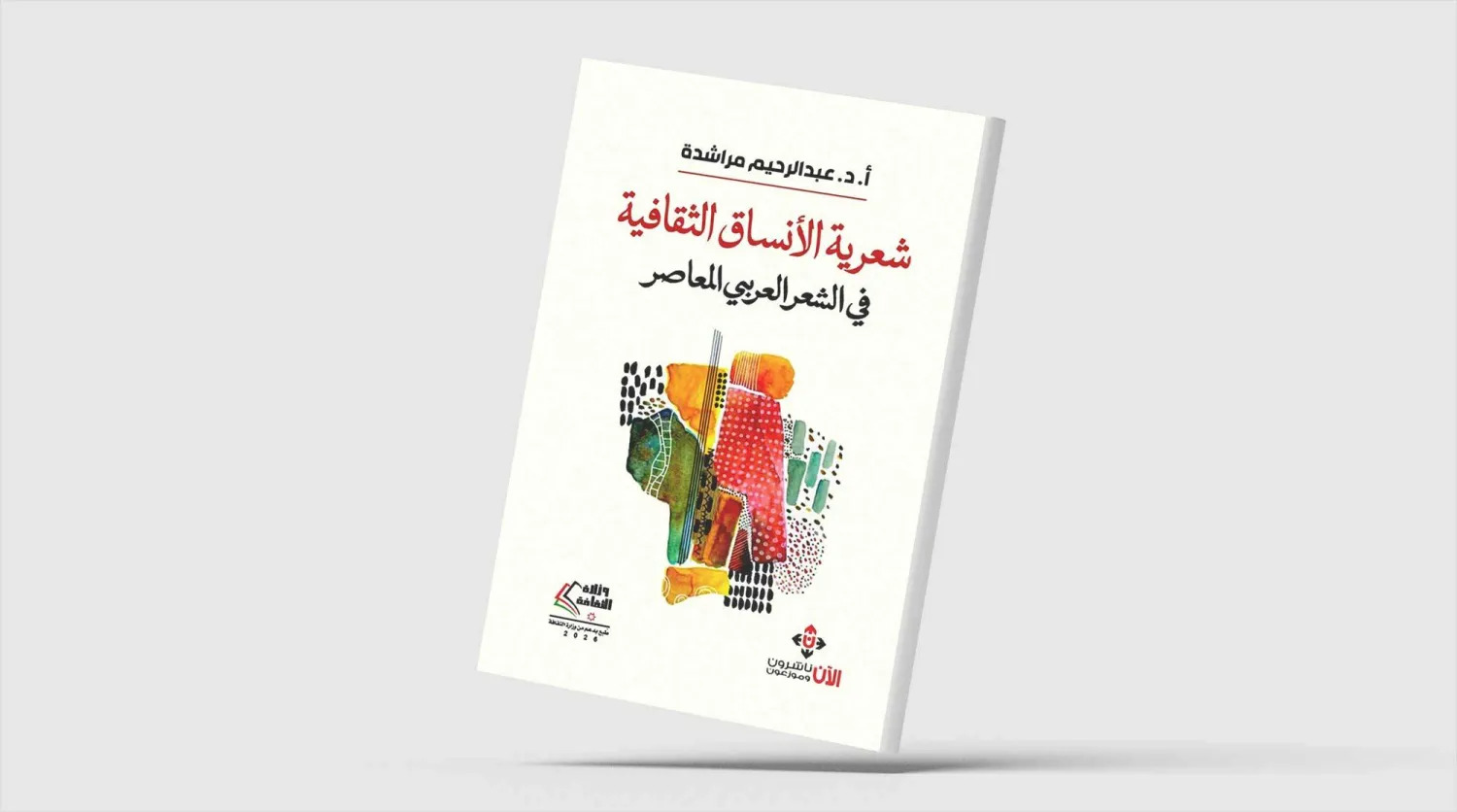
The Poetics of Cultural Structures in Contemporary Arabic Poetry, by Jordanian critic, academic, and poet Dr. Abdul Rahim Marashdeh, represents a critical attempt to bridge the aesthetic dimensions of poetry with its deeper cultural foundations, while opening new pathways for reading Arabic poetry as a space where language, thought, memory, and civilization intersect.
Published in 2026 by Now Publishers and Distributors in Jordan, the 230-page book explores the deeper layers of modern Arabic poetic texts. It moves beyond purely aesthetic readings to uncover the cultural references and underlying structures embedded within poetic discourse. The work examines the relationship between poetry, culture, history, and thought, offering an interpretive approach that reveals the meanings, visions, and cultural dominants concealed beneath the surface of language.
In the introduction, Marashdeh notes that the study of cultural structures has become a prominent field within contemporary cultural criticism, both in Western and Arab scholarship. This critical approach, he argues, enables researchers to explore meanings that transcend the linguistic and aesthetic levels of a text, uncovering the intellectual, historical, and civilizational frameworks that shape it. He emphasizes that poetic texts are inseparable from their cultural sources, absorbing history, heritage, events, and diverse references that become integral to their artistic and semantic formation.
The book is divided into three chapters: “Cultural Structures: Vision and Formation,” “Sufism and Existentialism as Cultural Structures: A Reading of Two Poems from Modern Arabic Poetry,” and “The Emotional-Travel Cultural Structure.” All three chapters consist of applied critical studies examining selected works of modern Arabic poetry. Their aim is to provide readings that engage with contemporary critical methodologies—particularly cultural criticism—with its focus on latent structures and dominant forces operating both within and beyond the text.
Among the most significant literary models discussed is the work of poet Adonis, particularly his project The Book: Yesterday, the Place, Now. Marashdeh interprets this work as a problematic and boundary-defying text that transcends conventional literary genres and draws heavily on cultural, historical, and intellectual references. He argues that Adonis has consistently sought renewal, experimentation, and transgression, both in poetry and criticism, contributing significantly to the expansion of Arabic poetry into new artistic territories through his persistent efforts to challenge traditional forms.
The author also examines the work of Jordanian poet Taher Riyadh, focusing on his poem Hallaj of Time. Marashdeh identifies a strong presence of Sufi, philosophical, and existential references within the poem and explores how these references are transformed into poetic energy that drives the text.
In addition, the book analyzes other poetic models, including works by Nizar Qabbani and Adonis, tracing the presence of history, civilization, and intellectual inquiry in their poetry. Marashdeh argues that these writings represent an important stage in the evolution of modern Arabic poetry, whether in terms of poetic language, modes of expression, or openness to multiple cultural influences.
The study also addresses the work of Jordanian poet Omar Abu Al-Hayja, particularly his collection And the Dust Came Forward, which Marashdeh views as a poetic experience in which memory, place, national concerns, and humanistic dimensions intersect.
Furthermore, the author devotes considerable attention to the poetry of Jordanian critic and writer Nasser Al-Din Al-Assad, tracing the presence of selfhood, memory, and human values throughout his poetic experience, as well as its connection to emotion, nature, and a distinctive vision of the world.
Originally published in Asharq Al-Awsat.
Most read