
In recent years, the American political landscape has been witnessing structural shifts in the electoral mood, particularly within the Democratic Party (United States), where the progressive wing has been steadily expanding. This current brings together liberal leftists and activists from diverse ethnic and religious backgrounds, including Muslims, Arabs, Africans, and Latino Americans.
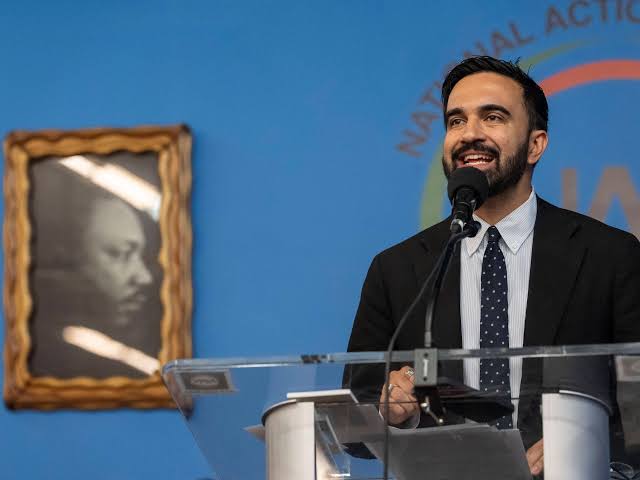
Zohran Mamdani, an American politician of Ugandan Muslim origin, represents a model of this emerging current that challenges the traditional rules of American political influence—long shaped by money, lobbying networks, and conventional media power.
The Symbolism of Zohran Mamdani as a Political Case
Challenging the Political Money Machine
If Mamdani’s campaign succeeds in breaking through the financial and media ceiling imposed by the Democratic establishment, it would represent a symbolic precedent. His victory would signal that value-driven discourse—centered on justice, human rights, and positions on Palestine—can prevail over financial power and institutional influence.
Transforming Sympathy for Palestine from Moral Discourse to Electoral Capital
Until recently, advocating for Palestinian rights was widely seen as a political risk in the United States. However, the electoral success of figures such as Rashida Tlaib and Ilhan Omar—along with their allies—has moved pro-Palestinian discourse into the mainstream electoral arena.
A potential victory for Mamdani would mark a qualitative shift from individual expressions of sympathy to a more organized electoral mobilization.
Identity and Political Coalition
Mamdani embodies a coalition of historically marginalized identities: women, minorities, immigrants, and Muslims. This coalition is increasingly transforming into a tangible electoral bloc, particularly in major urban centers such as New York City, Detroit, and Minnesota.
His success would signal that American voters are no longer confined to the traditional political binary often associated with white evangelical dominance but are moving toward a more diverse political representation.
Potential Impact on Upcoming Midterm Elections
1. Within the Democratic Party
A Mamdani victory would strengthen the progressive wing led by figures such as Alexandria Ocasio-Cortez and Bernie Sanders.
Such success might also push the Democratic establishment to reconsider its traditionally pro-Israel rhetoric—or at least soften its tone.
At the same time, it could intensify internal conflict between the party’s centrist, establishment-oriented faction (closely linked to major lobbying networks) and its younger, left-leaning progressive base.
2. For the Republican Party
Republicans are likely to view this shift as a threat—not only because of positions related to Israel but also because the rise of this generation suggests a gradual erosion of the influence of conservative values and the religious right.
The Republican Party (United States) would likely frame Mamdani’s success as evidence of “excessive leftism” threatening American identity as defined by the conservative movement, using it as a mobilizing tool for its electoral base.
Impact on Public Discourse
A Mamdani victory could also reshape several key debates in American politics:
- Reviving discussion around “money in politics.”
- Reopening debate about the influence of the Israeli lobbying organization American Israel Public Affairs Committee (AIPAC) in shaping candidate endorsements and political funding.
- Bringing the issue of Palestine into the core of electoral polarization rather than leaving it as a marginal or external issue in public debate.
Risks and Opportunities
Opportunities
- Strengthening the political presence of Muslims and Arabs in the American political arena.
- Growing grassroots awareness within the Democratic Party regarding international justice and human rights issues.
- Breaking the near-monopoly of pro-Israel discourse within the United States Congress.
Risks
- A backlash from financial and media lobbying networks seeking to contain similar electoral advances.
- Attempts to stigmatize the progressive movement as “anti-American” or “anti-Israel.”
- Potential fragmentation within the Democratic Party’s internal alliances, which could benefit Republicans electorally.
Strategic Interpretation
If Zohran Mamdani were to win, it would not simply be viewed as a local victory in New York. Rather, it would likely be interpreted as a strategic indicator of a deeper transformation in American political consciousness:
- A shift from “surface-level liberalism” toward a more value-driven left.
- The use of moral positions on Palestine as an electoral mobilization tool.
- A gradual weakening of the dominance of money and traditional media in shaping political decision-making.
This could mean that the upcoming midterm elections may produce real surprises if similar models emerge in other districts—especially as younger progressive bases become increasingly active following the Gaza war 2024–2025, which has left a profound impact on American public opinion.
Concluding Assessment
If it materializes, a Zohran Mamdani victory would represent a genuine test of the balance of power within the Democratic Party. It would also signal the beginning of a new phase in which sympathy for Palestine becomes politicized and transformed into electoral capital.
In Washington, such an outcome would likely be interpreted as both a cultural and political shift in the American mood toward a new, multi-identity left—one that challenges the centrality of financial and media influence and redefines the boundaries of what is politically possible in the United States.
Most read



Read also