“Baghdadi Petition”: An Elegy for Contemporary Baghdad

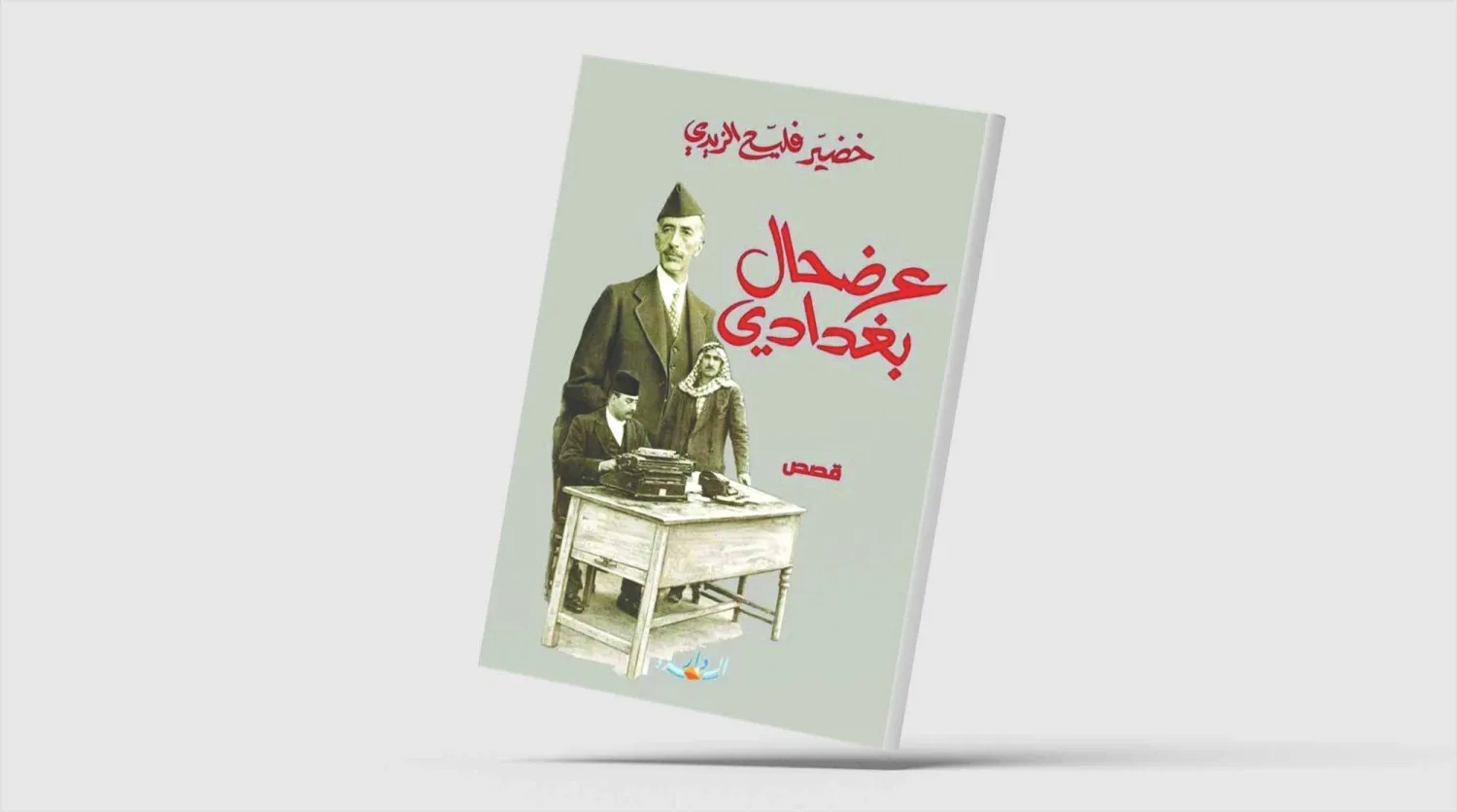
Khudair Faleh Al-Zaidi’s Baghdadi Petition does not read like a conventional short-story collection composed of independent narratives. Rather, it resembles a fragmented novel whose many faces tell a single story. The characters scattered throughout the collection do not merely perform individual roles; together, they form parts of a larger portrait—that of Iraqi society over the past four decades. This is where the collection’s artistic value lies: its characters become mirrors reflecting the psychological, social, and moral fragmentation that has afflicted Iraqi society.
French critic Philip Hamon views the literary character as a cultural and social “sign.” From this perspective, the characters in Al-Zaidi’s collection can be seen less as autonomous individuals than as representations of social groups. The laborer, the spinster, the poet, the soldier, the thief, and the intellectual all become symbols revealing the decline of Iraq’s moral and symbolic order.
Al-Zaidi offers no central hero because heroism itself appears impossible in a world that has lost its certainties. Instead, he chooses marginal figures: a simple worker, a lonely woman, a forgotten poet, an absent soldier, a thief, a clerk, or a man who spends his life waiting. Together, they represent different manifestations of a single Iraqi human being exhausted by wars, sanctions, and political upheavals, gradually stripped of the ability to dream.
Baghdad itself emerges as the collection’s hidden protagonist. A city deprived of many of its civilizational features, it becomes more than a setting for events; it is the major character speaking through its broken inhabitants. Through black humor and irony, Al-Zaidi exposes the contradiction between slogans and reality in a world where values have been inverted: the tavern is safer than the homeland, thieves are more honorable than society, and a donkey possesses greater awareness of dignity than a human being. Through such paradoxes, the author constructs a narrative universe dedicated to exposing falsehood and revealing social dysfunction.
The Postwar Human Condition
The collection’s characters reveal the impact of a long history of violence and warfare—not through direct political discourse, but through their psychological makeup. War here is not an event confined to the past; it is an ongoing condition inhabiting the collective consciousness and continually reshaping behavior and human relationships.
The characters seem incapable of building stable life projects. No one possesses a clear dream; everyone is preoccupied merely with surviving the day. The spinster in The Spinster’s Autumn is not simply a woman who failed to marry. She represents a human being who spent her life serving a social system that ultimately gave her nothing in return, only to discover too late that the virtues she clung to had become the very instruments through which her life was denied.
Likewise, Hassan in Baghdadi Godot embodies the existential waiting that has defined an entire generation. His waiting is not for a particular person or event but for salvation itself—a salvation that never arrives. Through him, Al-Zaidi portrays a society whose middle class has eroded and whose grand aspirations have faded, until poverty itself has become a psychological condition that deprives individuals of the capacity to imagine a different future.
Distorted Human Relationships and Moral Collapse
The devastation caused by war has not been merely material. It has also impoverished people emotionally and morally. Human relationships throughout the collection appear damaged and incapable of fulfilling their natural purpose.
In The Donkey-Faced Man Smiled, this distortion reaches its peak. Human beings are reduced to creatures governed by instinct, while the donkey displays a moral awareness superior to that of humans.
The same irony appears in The Hyenas’ Wedding Night, where a courageous and competent woman becomes the victim of men who see her only as an object of desire. The woman rises morally while the men descend into pure instinct, creating a powerful indictment of a society that has lost its ethical balance.
In The Wife of a Marginal Man, silence does not signify harmony but rather the death of human connection. It is as though a society that has lost its capacity for dialogue has reproduced this failure within the family itself.
Another striking paradox appears in The Friday Night Thief. Here, the world of thieves seems governed by stronger ethical codes than the society outside it. The irony suggests that corruption is no longer confined to individuals but has infected the moral structure of society itself.
Culture in an Age of Ruin: The Death of Meaning and the Flattening of Consciousness
The collapse depicted by Al-Zaidi extends beyond the social and moral spheres into culture itself. He documents the decline of literature, the diminishing role of intellectuals, and the erosion of culture’s cognitive value within a society exhausted by crises.
In The Poet’s Daughter, the author presents a deeply bitter portrait of the intellectual’s fate. The poet is obscure, burdened by debt, and incapable of leaving a meaningful legacy. His punctured beret becomes a symbol of both material and creative poverty, while the inscription on his grave satirizes the tendency to inflate appearances and compensate for shallow experience with empty rhetoric.
This vision expands in Baghdadi Petition, where the tavern becomes a refuge for both intellectuals and petition writers alike. The image points to the flattening of consciousness and the reduction of writing to a purely technical skill, one in which the petition writer exerts greater influence than the genuine intellectual.
In Warmth Beneath Gogol’s Coat, a journalist who spends his life addressing the problems of others finds himself incapable of solving his own crisis, suggesting that knowledge itself has lost the power to save those who possess it.
Meanwhile, The Winged Elephant of the Story offers a direct critique of writing that replaces reality with ornamentation and imaginary heroics. Al-Zaidi clearly sides with ordinary people and bitter truths rather than rhetorical display and literary spectacle.
Culture thus emerges as part of the broader crisis. The intellectual has lost social standing, and the written word has forfeited much of its power to bring about change.
The Body and Identity
In The Spinster’s Autumn, the female body becomes a battleground between desire and the authority of social norms. The protagonist discovers that liberating oneself from external restrictions is easier than escaping the surveillance implanted within one’s own consciousness.
In Something Called My Father Is Chasing Me, a name itself becomes a sectarian and social marker that follows the individual wherever he goes, exposing the decline of an inclusive national identity in favor of competing sub-identities.
In Baghdadi Petition, irony reaches its highest point when the tavern proves more capable of providing security than either the homeland or the state. A marginal place performs the function that major institutions are supposed to fulfill, revealing the extent of dysfunction within the social and political order.
An Elegy for Baghdad and the Postwar Human Being
Baghdadi Petition succeeds in transforming the literary character into a cultural and social document that records the profound transformations experienced by Iraqi society through decades of war and violence. The spinster, the poet, the laborer, the thief, the absent soldier, the oppressed woman, and the broken intellectual are not separate individuals but multiple faces of a single human being living in the aftermath of historical catastrophe.
These characters reveal a consciousness burdened by collective disappointment. Grand dreams are no longer possible; survival has become the primary concern. Through this vast human panorama, Khudair Faleh Al-Zaidi offers an indirect history of Iraq’s devastation—not by recounting political events, but by depicting the fear, isolation, waiting, fractured relationships, and loss of faith in the future that those events have produced.
In this way, the characters transcend their individual limits and become metaphors for an entire society. Baghdadi Petition ultimately emerges as an elegy for contemporary Baghdad and a literary testimony to the postwar human condition—a human being who has lost much, yet continues to cling to a fragile thread of life and meaning.
Most read