How Boeing Aircraft Reveal the Transformation of Sudan's War

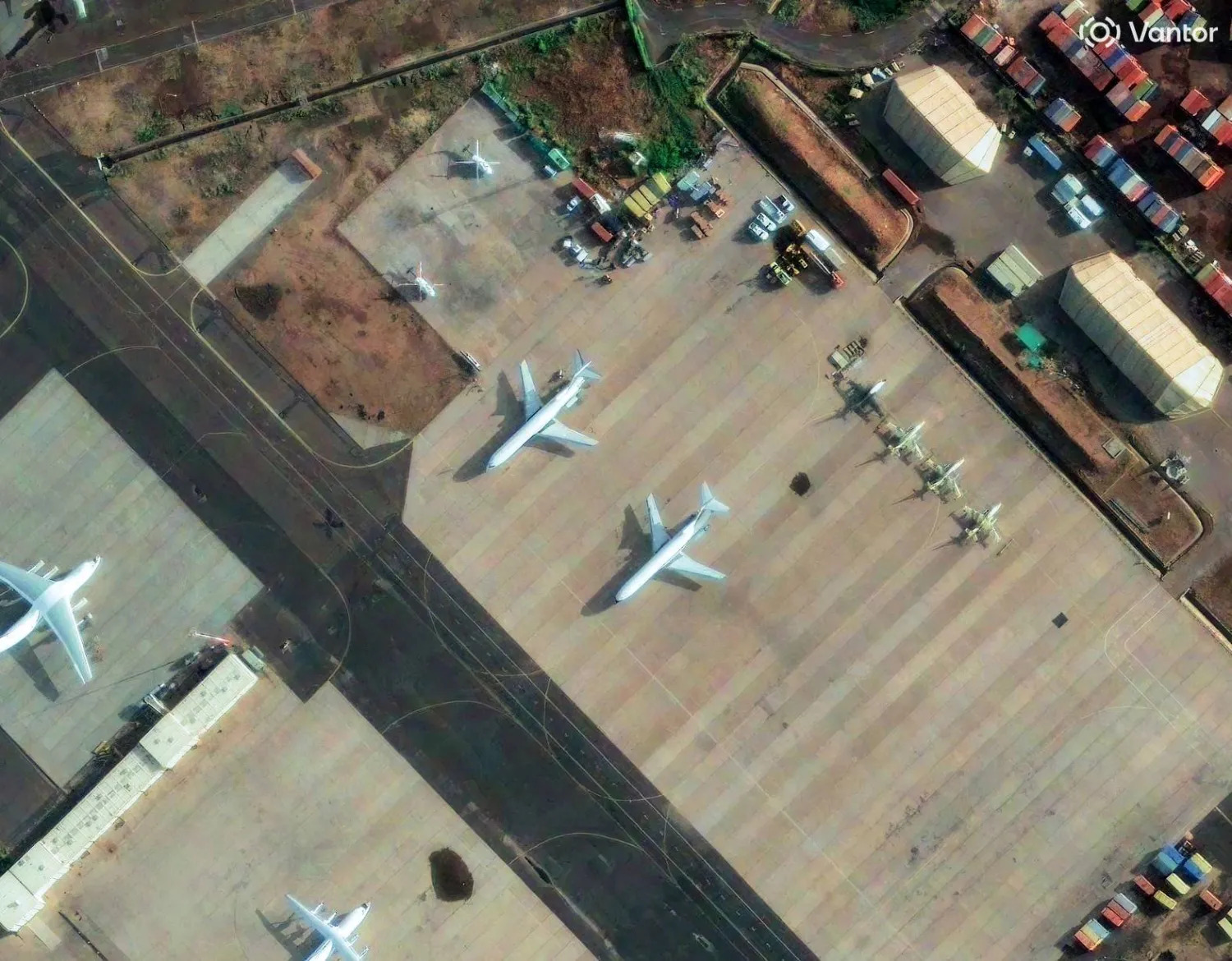
Sudan's conflict has evolved far beyond a conventional civil war between the Sudanese Armed Forces (SAF) and the Rapid Support Forces (RSF). It has become a complex twenty-first-century conflict in which private military contractors, transnational logistics networks, mercenaries, and repurposed civilian aircraft intersect with regional rivalries and international interests. The latest report by the United Nations Panel of Experts—scheduled for publication in September—offers a revealing glimpse into this transformation, documenting what amounts to an air bridge used to transport fighters, weapons, and drones into Darfur in support of the RSF.
The significance of the report lies not merely in confirming the existence of aerial supply operations, but in providing the most detailed UN account to date of the logistical infrastructure that has enabled the RSF to sustain its military capabilities despite the expansion of the conflict and the long-standing international arms embargo on Darfur.
A War Sustained by Cross-Border Logistics
The report demonstrates that Sudan's war no longer depends solely on traditional domestic supply routes. Instead, it has become embedded in a sophisticated regional logistics network stretching from Chad through Libya and as far as Somalia, utilizing aging commercial aircraft operating largely outside conventional air traffic monitoring systems.
This reflects one of the defining characteristics of contemporary warfare. Rather than relying exclusively on conventional military formations, modern conflicts increasingly depend on private transport companies, clandestine air corridors, and civilian-operated logistics networks that make tracking the movement of weapons and personnel considerably more difficult while reducing the effectiveness of traditional international monitoring mechanisms.
According to the report, Boeing 727 cargo aircraft conducted nighttime landings in Nyala, which has emerged over the past two years as the RSF's principal military and logistical hub in Darfur. These flights allegedly carried fighters, foreign mercenaries, weapons, and unmanned aerial systems. The findings reinforce earlier investigative journalism that traced flights between N'Djamena and RSF-controlled locations without detecting corresponding records in publicly accessible flight-tracking databases, suggesting deliberate efforts to conceal flight paths.
The Rise of the Privatized War Economy
The case also highlights another defining trend in modern conflict: the expanding role of private companies and former military contractors.
The UN report links the aircraft involved to a network of companies associated with a former American military contractor. While it presents no evidence of criminal liability or sanctions against either the individual or the companies concerned, the mere presence of private commercial entities within the military supply chain illustrates a broader transformation in contemporary warfare. Increasingly, logistical support, transportation, maintenance, and procurement—functions once monopolized by national armed forces—are being outsourced to private actors operating across multiple jurisdictions.
This development raises complex legal and political questions. Determining accountability becomes significantly more challenging when companies operate through multinational ownership structures, conduct business across several countries, and function in environments where regulatory oversight is weak or fragmented.
Chad: The Critical Link
Perhaps the most politically sensitive aspect of the report concerns Chad.
According to the Panel of Experts, the aircraft departed from the military section of N'Djamena International Airport before flying into Nyala. Chadian authorities have acknowledged that the aircraft were never granted civilian operating permits while emphasizing that military flights fall under national defense secrecy.
Although the report stops short of accusing the Chadian government of direct involvement in the alleged supply operations, the apparent use of Chadian territory as a logistical hub once again underscores the fragility of Sudan's western frontier and the difficulty of separating security concerns from regional political realities in the Sahel.
Chad's geographical position makes it indispensable to any serious assessment of the Sudanese conflict—not only as a host for hundreds of thousands of Sudanese refugees but also as one of the principal logistical gateways into Darfur.
Mercenaries and the Internationalization of the Conflict
One of the report's most striking findings concerns the alleged presence of between 1,500 and 2,000 Colombian mercenaries fighting alongside the RSF.
If accurate, these estimates place Sudan alongside an expanding list of contemporary conflicts—including Libya, Ukraine, and several Sahel states—in which foreign contractors and mercenary forces play increasingly significant operational roles.
Their contribution reportedly extends well beyond frontline combat. According to the report, Colombian fighters have participated in operating drones, providing tactical planning, and supporting military operations during the siege and eventual capture of El Fasher. This reflects a broader transformation in warfare, where specialized military expertise increasingly outweighs numerical superiority in determining battlefield effectiveness.
A Test of the United Nations Sanctions Regime
The report also raises fundamental questions regarding the effectiveness of international sanctions.
The arms embargo on Darfur has remained in force for more than two decades. Yet, according to the Panel of Experts, the RSF appears to have developed a sustained aerial supply network capable of transporting weapons, military equipment, and personnel over an extended period.
This reality calls into question the international community's capacity to enforce its own decisions in an era characterized by sophisticated sanctions evasion techniques, expanding private-sector involvement, and increasingly complex transnational logistics.
More broadly, the findings expose the limitations of the Security Council's enforcement mechanisms in conflicts where regional interests, private commercial actors, and geopolitical competition overlap. Documenting violations has become considerably easier than preventing them.
Darfur as the Strategic Center of Gravity
The report further confirms that Nyala has evolved beyond its traditional role as South Darfur's largest city. It now functions as the operational heart of the RSF's military infrastructure, serving as the principal hub for logistics, reinforcement, and command.
This helps explain the strategic importance of El Fasher, the last major urban center in Darfur outside RSF control for much of the conflict. The battle has never been solely about controlling territory; it has centered on dominating the logistical architecture that increasingly determines the trajectory of the war itself.
Beyond the Report
The publication of the UN findings is unlikely to alter the military balance on the ground in the immediate future. Nevertheless, it represents a significant milestone in documenting Sudan's transformation from an internal political conflict into a multidimensional regional war involving private contractors, foreign mercenaries, transnational logistics networks, and multiple external actors.
The report's greatest significance therefore lies not simply in revealing the existence of Boeing aircraft or Colombian mercenaries, but in illustrating how the Sudanese conflict has become embedded within a broader regional and international security ecosystem—one that increasingly operates beyond the reach of national borders and conventional sanctions regimes.
Unless the international community moves beyond documenting violations toward dismantling the financial, logistical, and military networks that sustain the conflict, Sudan's war is likely to become even more deeply entrenched. The air bridge described by the UN is more than a transportation corridor; it is a symbol of a profound structural transformation in modern warfare, where logistics have become as decisive as firepower itself in determining whether conflicts endure or come to an end.
Most read